

how to earn more by deciding less
financial hot girl #54
I talk a lot about the power of discipline, especially in your financial life. But in reality, you know what helps us build discipline? Having the time and mental energy to focus on showing up.
And you know what sucks that energy right up? Decision fatigue. Especially if you’re an ambitious overthinker.
We need fewer decisions.
The average adult makes over 35,000 decisions daily. What to wear, what to eat, when to reply, where to spend. Even tiny ones drain mental energy.
By 5pm, your brain is usually fried, and that’s when the worst spending, eating, and productivity decisions happen. Studies in the US even show that judges were more likely to grant parole right after a break.
There’s a fix for this: the financial hottie’s “Decide Once” principle.
You make the decision one time, set up the system, and never waste energy on it again.
Here’s how to apply it in three areas that matter most.
P.S. this week we’re finally launching Dear Financial Hot Girl. A crazy number of you have submitted your questions, dilemmas and sticky situations and we’ll be answering them anonymously!
𝜗ৎ In this issue:
QUICK NOTE: In August, all paid subscribers will be in for a chance to get their next book purchase on me (I also have recs!) and a 1:1 catch-up. This is on top of a matcha/coffee on me, access to Rich Girl Blueprints, a resource bank of mini-masterclasses and tutorials.
Decision fatigue can be caused by this hidden reason
The other reason we get stuck in decision fatigue is because of a lack of self-trust.
When you believe every choice has to be the “right” one, you freeze. You hesitate, overthink, or avoid making the decision altogether. And the longer you delay, the more it reinforces the idea that you can’t trust yourself.
The Decide Once principle is less about getting it perfect first time. It’s more about proving to yourself that you can make a decision, commit to it, and move forward. Remember that each small follow-through builds more self-trust.
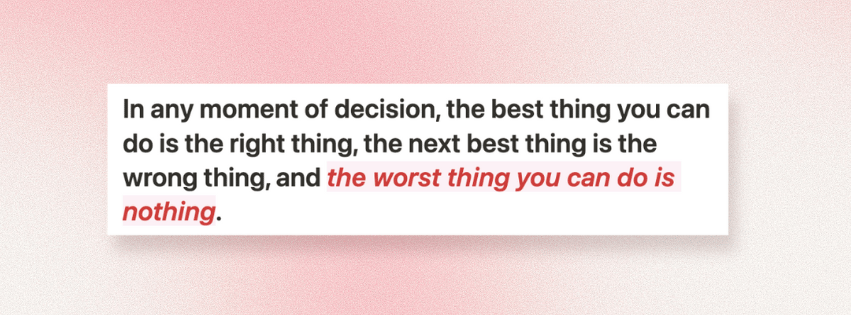
Decide Once to build wealth
Decision fatigue costs you money. Read that again! It costs. You. Money.
It’s why you forget to transfer to savings, miss bill payments, or impulse-buy to solve problems you could have avoided.
Decide Once, financially, by:
Automating bill payments
Setting a standing order into investments.
Meal planning for the week so you skip lunch/dinner out when your day is more stressful than you’d planned.
Removing the decision removes the chance for your tired brain to derail your goals.
Decide once to look put-together
If your clothes don’t work together, you’re paying more for less. A wardrobe with no formula means more “fix” purchases that are just temporary solutions to permanent problems, more stress when you’re getting dressed, and ultimately less money in your pockets.
Decide once by creating a Personal Uniform:
Pick 1–2 silhouettes that always work for you.
Decide on 2–3 colour palettes.
Take pictures of your favourite outfits and log them in your phone for reference.
My weekday content uniform is wide-leg trousers + a Skims t-shirt in neutral and muted tones. It takes seconds to get dressed, zero brain space and I feel amazing.
Decide once to be more productive
You lose hours deciding when to do things, and what things to do, instead of doing them when you need to do them (yes, that hurts to read).
Decide Once by:
Blocking recurring times for focused work.
Assigning set days for errands and admin.
Plan your time to plan (I’m not joking).
Your future self gets the benefits without re-negotiating with your present self every morning. Negotiating with yourself is a time-suck and one of the most wasteful ways to use our energy.

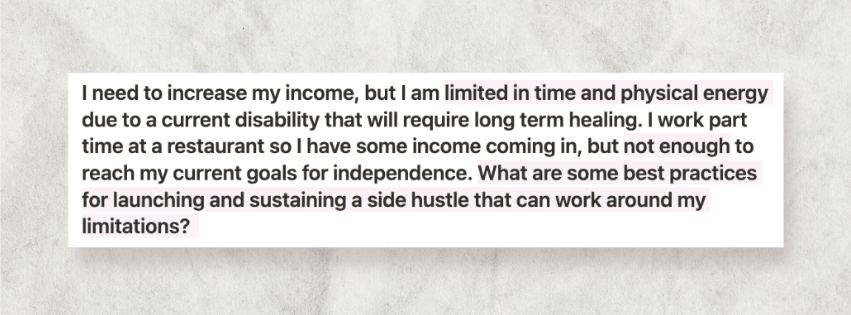
First, I just want to say that your limits don’t make you less capable of building wealth. Looking at our limitations means looking at the ways we individually need to map how to achieve a certain goal. We can look at what we think are our limitations as signs for how to build out our own path.
And in your case, a goal means income that respects your time and energy.
P.S. a really great book to help you think this through is Million Dollar Weekend by Noah Kagan.
You’ve already got two strengths: steady income from your part-time job and a clear goal: independence. Here’s how I’d approach this:
1. Start with a skills audit
Write down three columns: skills you use at work, skills you enjoy, and things friends ask you for help with. Circle any and all overlaps. That’s your shortlist for potential income streams. For example:
Customer service at the restaurant → remote inbox management.
Scheduling shifts → virtual assistant tasks.
Talking people through menus → online tutoring.
Pick one skill to package into a service.
2. Choose a low-energy format
Go for offers you can deliver from home in short bursts. Examples:
One-off templates or checklists.
Simple services with clear deliverables (like proofreading or inbox sorting).
Coaching or tutoring in 30-minute blocks.
Avoid anything that ties you to long hours, constant client calls, or heavy physical effort. This is key so that over time, you’re not working against yourself and you have the discipline to build a sustainable side income.
3. Test demand quickly
Before building a whole business, test your idea:
Post one offer on Fiverr, Upwork, or a local Facebook group.
Offer it to two friends and ask for honest feedback.
Share one practical tip related to your skill on social media.
It might feel hard to put something into action that won’t have a clear path, but the clear path here is to figure out what works and what doesn’t so that you don’t spend longer doing the stuff that doesn’t.
4. Batch your energy
Decide your working rhythm:
High-energy days → delivery and creation.
Low-energy days → admin, light marketing, or scheduling.
Plan around the energy you do have, not the energy you wish you had, or the energy that everybody else ‘seems’ to have. This is how you stay consistent.
5. Automate EARLY
Use free or cheap tools:
Google Calendar for recurring tasks.
Canva templates for marketing posts.
PayPal or Stripe for invoices.
The less admin you repeat, the more energy you save for income-generating work. Automation isn’t the first priority, but it’s something to keep in mind when you start because nailing this will be key to helping your additional income work around your limitations.
6. Set your “enough” number
Arguably the most important step that I’ve listed as #6, but anyway… work out the gap between your current income and what you need for independence. That’s your first target. Without a clear target, you risk overcommitting your energy chasing more, even when you’ve met your real needs.
Example: if you need £400 more a month, focus on creating one offer that brings in £100 per week. When you hit it, pause and stabilise before chasing more.
Start with one offer. Keep it simple. Track how much energy it costs versus how much income it brings. That feedback loop will show you what’s sustainable.
Remember that not all side hustles need to look the same. It needs to work for your body, your time, and your goals.
— Financial Hot Girl
This newsletter and everything shared in it is to help you build a well-rounded, aspirational life that includes money. I hope it was able to do that today 🫶
— Dev xo