

if you skip this, nothing in your life will change
the truth about adulting nobody tells you | fhg #69

Happy Sunday financial hotties,
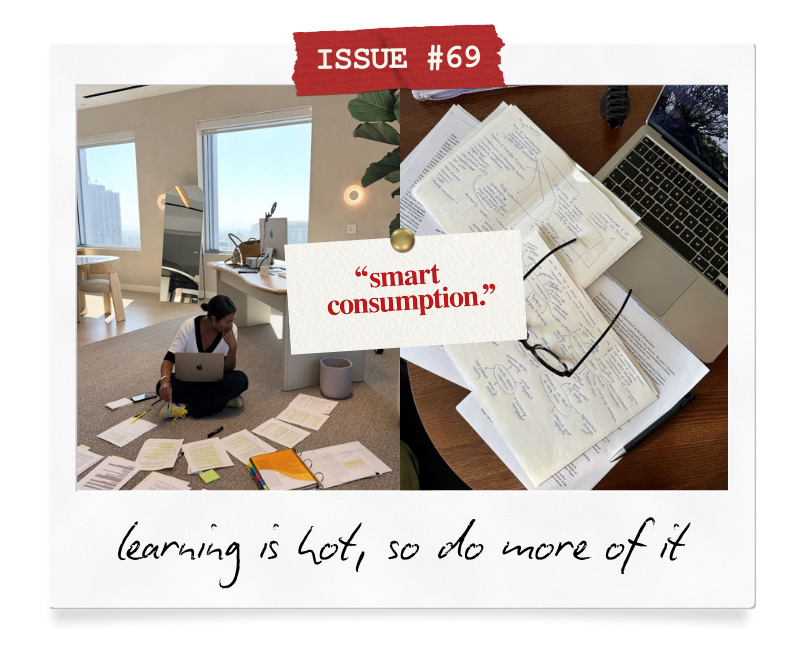
If you started a twelve-week personal curriculum in September, today is your finish line. And if you didn’t, you’re not behind—it’s okay. You’re starting from a clean slate, which is its very own advantage.
Either way, this is a good moment to pause and look at your learning habits, because learning as an adult is uncomfortable and easy to avoid.
But it’s also the thing that expands your income, your thinking, and the way you see yourself. So let’s talk about what to learn next, how to make it stick, and how to build your next twelve-week curriculum in a way your future self will thank you for.
Is your world staying the same size?
Most adults stop learning without noticing. Life becomes a loop—work, chores, routine, recovery.
And the brain loves loops. Loops use less energy.
But research from the University of Chicago shows that people who keep learning new skills report higher long-term life satisfaction because they create more novelty, more competence, and more opportunities.
When you’re not learning, your world stays the same size. Your income hits the same ceiling. Your confidence stays flat. Your ideas repeat. Nothing expands because nothing new is entering your mind. Learning is what stretches the edges of your life.
The people who feel “lucky” or “in demand” are usually the ones who kept learning when others stopped. They upgraded their thinking, which upgraded their earning power. And that’s available to you too.
Your brain resists learning because it’s wired to conserve energy
When you’re learning, your brain has to focus, recall, analyse, apply, repeat, question, etc. It’s like going to the gym for your brain, it burns real cognitive energy, and it’s why learning just feels hard as an adult.
That discomfort is actually your advantage. The harder something feels while you learn it, the more your brain retains it. This is called desirable difficulty, a concept backed by cognitive psychologists like Robert Bjork.
If it feels a bit painful, it’s actually working—something I remind myself when Spanish lessons make me feel extra dumb.
So when your brain tries to pull you back to comfort, that’s not a sign to stop. It’s a sign that you’re in the exact zone where real skill and identity shifts happen.
What to learn if you want your life to look different in 2026
A new year won’t change anything unless your skills change too. Your future income, opportunities, and confidence sit on top of what you know.
If you want your life to look different in 2026, learn the skills that create different results.
If you want to increase your income:
Negotiation
Personal branding
Storytelling
Sales psychology
If you want to level up your creative career:
Writing for an audience
Editing
Photography
Presentation skills
Scripting
Building a body of work
Content systems
If you want to get financially confident:
Investing basics (we recommend Friends That Invest)
Behavioural finance (read Morgan Housel’s books)
Tax literacy
Understand company reports
If you want to rebuild your identity:
Self-trust vs self-confidence
Nervous system regulation
Habit and lifestyle design
Time management
Journaling
Pick a lane and pick just three topics. That alone can shape your next twelve weeks!
The 12-week curriculum formula that works every time
A twelve-week curriculum works because it’s long enough to create real neural change, but short enough that your brain doesn’t rebel.
Plus, research on habit formation shows that meaningful behavioural change often takes 8–12 weeks, not 21 days.
Step 1: Choose a North Star
What version of you do you want to be by February? Pick ONE characteristic or defining aspect.
Step 2: Choose three topics that align with your North Star
ONE topic per four-week block.
Step 3: Choose one book, one resource, one assignment per block (4-week period).
For each topic, choose one book, one resource (a course or playlist), and one assignment that forces you to practice rather than passively consume.
Step 4: Pick your learning rhythm
Your rhythm should be tiny and consistent. Your output is what matters: one takeaway per day, one small assignment per week, and one reflection per month. This is how learning sticks without becoming a burden.
Step 5: Measure output, not hours
One takeaway a day, one assignment a week, one reflection per block.
If you finished your 12 weeks today, here’s what you might not realise yet
You might not feel dramatically different, but your brain is. Repetition and effort build new neural pathways, and research shows that identity shifts often lag behind the behaviour that created them.
You literally become the person first, then you feel like them later!
Your focus is sharper than it was twelve weeks ago. Your confidence is higher. Your thinking is wider. You’ve proven you can commit to something difficult, which already separates you from most adults who stopped learning years ago.
And the best part is this: your next twelve weeks will be easier. You have momentum now. You’ve built the muscle. This is how your life expands quietly at first, then suddenly all at once.