

is saying no to motherhood the new money mindset?
+ the skill that created more millionaires than any VC

Happy Sunday financial hotties ❤️🔥 This week I’ve been thinking all about motherhood and childlessness because of that viral NY times article (paywalled link here - p.s. I don’t really agree with it at all).
I also noticed Sam Altman hired Fidji Simo as CEO for OpenAI’s applications arm, and alongside news of Alix Earle making some big business moves I couldn’t help but notice that there’s something in common between these two women that makes millions.
Let’s get into it!!
In this issue:
Quick note: we’ve launched the group chat over on IG broadcasts. Join here and get involved in episode research so we can have more inclusive conversations!
The business of being childfree
Before we start… we’re 5 episodes in and I’ve just launched our financial hot girl broadcast channel, because I want to involve you in the episodes.
I am strong in my belief that despite living in a small city in Scotland, I can still make a big impact on your life. And that’s by opening up the conversation to you. So whether that’s through the broadcast channel or by continuing to reply to this newsletter (you can also comment on these if you click ‘read online’ at the top of this).
Now, back to business. Something I’m deep in the research phase for is about how more of us are choosing not to have children and caring less about motherhood. The NY times article I linked highlighted some good reasons why, but then went on to be a bit silly IMO. But that’s beside the point.
Having a child is a huge responsibility I’m very aware of. Having and raising a sentient, independent human that owes you nothing is a difficult thing to do, because we live in a society that doesn’t yet nurture mothers.
Why this convo matters (even if you’re pro-kids, kid-curious, or kid-NEVER)
Money maths: The average UK cost of raising a child to age 18 is now north of £200k… that’s a London flat-deposit or ten index-fund “baby ISAs.”
Identity maths: Parenthood is beautiful and identity-defining; but opting out can be just as intentional and purpose-filled. It’s not one or the other.
Freedom maths: Time is the compound-interest nobody quotes. Whether it’s a PhD, a six-figure side hustle, or a year in Bali, child-free bandwidth is real capital.
I want your hot takes!
If you’re happily child-free: What was the tipping-point moment (or series of micro-moments) that made the decision feel right?
If you’ve felt the social pressure: What’s the most annoying question you’ve been asked about motherhood?
If you’re on the fence: What data, story, or reassurance would help you decide with confidence?
Send in it the group chat here or reply to this email with your thoughts. I’ll be sharing everything in the next FHG episode 💌
The skill that makes millionaires
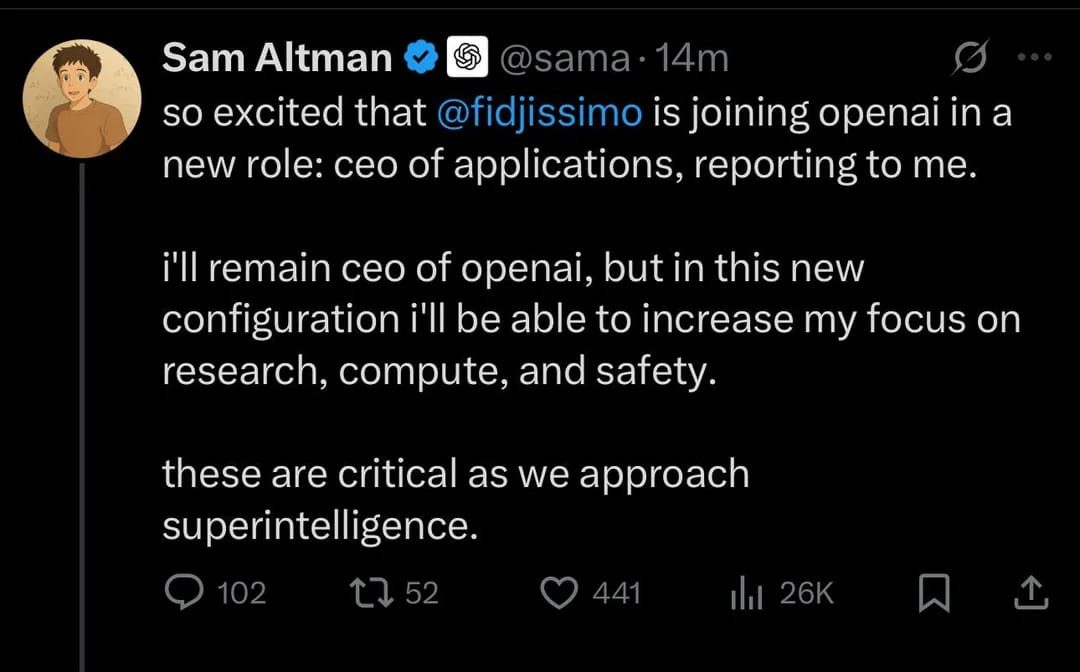
In recent weeks we’ve seen Fidji Simo (previously CEO of Instacart and head of apps at Facebook) take on a new CEO role at OpenAI. We’ve also seen Alix Earle investing and taking on an ambassador role at Sipmargs, a canned margarita brand.
I couldn’t help but notice they share the ability to do one thing: mastering the pivot.
Pivoting = making a thousand tiny course-corrections before you ever need one giant U-turn.
Fidji pivoted with her team every week for a year before Facebook Live ended up quadrupling watch time. Her initial job at Facebook wasn’t even video related: she just noticed that live video could be an opportunity and encouraged her team to pivot toward it.
Alix went from GRWMs to podcasting and walked away from the Alex Cooper Unwell Network after just over a year, rerouting her audience to her YouTube channel while she navigated her next steps. She ended up investing in Poppi, getting an 8-figure return and doubling down when she then invested in Sipmargs, adding herself as the face of the brand this time.
Both of these careers show me that small, intentional pivots can have big rewards, especially if you’re regularly reflecting and willing to make a change when you have new information in front of you.
I did it by pivoting out of accounting, then consulting, into content creation and now into brand building.
Regularly ask yourself:
Are your goals actually your goals (do you even like them and want to achieve them?)
Are your recent decisions in line with your goals?
These two questions can help you decide if you need to pivot or course correct, whether that’s through scheduling your day differently or making a bigger, scarier change.
Have a great week and as per usual, see you in the comments with your thoughts (click ‘read online’ at the top and you can add comments)!!! It’s been a juicy one this week.
Devamsha xo