

the real reason you think other people are lucky
a softer, more honest look at why big decisions scare us | fhg #71

Happy Sunday, financial hotties. This week we’ve got a reader submission, make sure you catch it at the bottom of the email 🫶 Submit your own dilemma here.
It was 4.15am, pitch black, on a shuttle bus in Guatemala, when I overheard a conversation between two travellers. Let’s call them Girl A and Girl B:
Girl A: “I quit my job a few months ago so I could travel longer.”
Girl B, with a tiny laugh: “You quit?! What a luxury. I don’t have that—just two weeks here.”
Girl B’s use of the word ‘luxury’ just sat with me for a while. Her response was immediate, and I was going back and forth in my mind between whether it was rude of her to say that, or if she had just cause.
Maybe she truly felt like being able to quit your job was a luxury—maybe she didn’t have capacity in her life for career risk.
But what if she could take that risk, but she just needed to put a safe, comfortable distance between herself and the possibility of doing something like that?
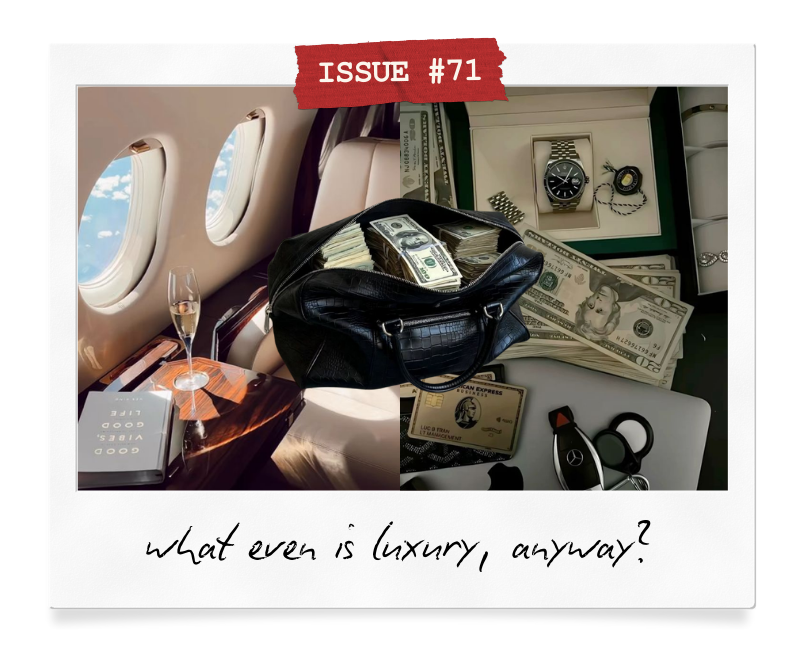
Is quitting your job a luxury? And what even is luxury nowadays, anyway?
The problem with ‘luxury’
Whenever we see someone doing something bold, we immediately look for words that ease the discomfort it might stir within us.
Be honest with yourself when reading this (only you know what you’re thinking right now): what do you think of when you see people achieve the things you want for yourself?
Do you assume they’re privileged, lucky, have the ‘personality’ for it or didn’t have XYZ struggle that you have?
All of these phrases and thoughts soften the blow of someone doing something we secretly wish we had the capacity to even consider.
But these phrases let us avoid three Big Things:
the fear sitting behind our own decisions
the lack of safety we feel in our own lives
the stories we tell ourselves about what we can and cannot do
And the most uncomfortable truth of it all—something you learn with more empathy, open-mindedness and cultural awareness—is that most people’s ‘luxurious’ decisions are sitting on piles of sacrifice that you will never, ever, get to see.
What’s really at stake
When you call someone’s decision a luxury, you don’t have to look at what it cost them. And you definitely don’t have to look at what it would cost you.
But the cost of a decision is truly the whole point. That’s where the self-awareness and agency lives, i.e. the ability to think about the factors at stake and actually do something about it.
The second you stop asking, “Why is this a luxury?” and start asking, “What do I need to feel safe doing something like this?” your perspective shifts in a very tangible way.
Thinking about what you need for psychological safety allows you to stop comparing yourself to others.
You simply stop having the mental bandwidth to do it, because you’ll start to get more preoccupied with how you can plan for your own steps forward.
You start having the capacity to take action on your own ‘luxurious’ decisions.
The beliefs worth upgrading
Girl B on the bus wasn’t being rude. She wasn’t judging Girl A. She wasn’t even judging herself. She was very likely protecting herself mentally.
Quitting a job certainly isn’t a handbag purchase. It’s an identity shift that takes a lot of courage to make, whether it’s your first time or fifth time doing it.
It requires savings, self-trust, clarity, evidence you can earn outside a payslip, tolerance for uncertainty, and the emotional bandwidth to wobble for a bit. Things that are difficult to have, let alone build.
Most people simply aren’t set up to carry that risk. But it has nothing to do with being ambitious, and everything to do with how strong your safety net is.
And saying “must be nice” is easier than saying “that scares me”. So here are some belief upgrades worth borrowing, in order to build that mental safety net.
Belief 1: “Quitting is a luxury.”
No. You’re imagining the last day, not the six months of spreadsheets, overthinking, panic, planning, and rebuilding. Quitting is a skill, not softness only few can afford.
Belief 2: “People who quit are lucky.”
Luck didn’t get me a nine-month quit fund when I quit corporate. Luck didn’t build evidence or self-trust. Preparation and (ugly) discipline did.
Belief 3: “They’re bragging.”
Most people aren’t bragging. They’re relieved. They’re scared. They’re trying to steady their nervous system. Sometimes sharing is a way of saying, “Please tell me I didn’t ruin my life.”
Honestly, I’m speaking from experience those first few months I had to say out loud that I quit corporate to create content.
Behavioural psychology even shows that when people feel unsafe or under-resourced, they judge others more harshly. It’s a self-protection mechanism, a way to put distance between you and that risque decision.
A better way to look at “big, scary choices”
Here’s the process I (try to) use now, and it’s one you can steal:
1. Ask what the decision costs them.
Not what it symbolises about their life, but it actually costs. Time, identity, money, fear, a year of internal negotiations.
2. Ask why you feel reactive.
Jealousy, defensiveness, judgement — it’s all data. They point to something you want but haven’t admitted yet. This is a great way to stop criticising yourself, separate your emotions from the data it’s showing you.
3. Ask what you would need to feel safe.
Not to do it now or even to do it perfectly, but just to feel psychologically safe enough to consider it. Is it money, time, a network? Put a real and tangible answer behind this question.
4. Build the preconditions instead of the decision itself.
Safety. Skills. Self-trust. A buffer. Evidence (see point 2). These are the real, buildable luxuries.
5. Honestly…stop calling things luxuries.
Call them what they are: Preparation. Sacrifice. Self-trust. Strategy. That’s how you move from spectator to participant in your own life.
If you take anything from this issue, let it be this.
Big decisions aren’t reserved for lucky people. They’re built slowly and often without applause or recognition.
So instead of asking whether you’re “the kind of person who could ever do something like that,” ask what kind of support, structure, and safety you’d need to become that person.
And if you want to share your answer, I’m right here, I read every reply! So let’s chat.
P.S. have more conversations like this with people, too. Open your mind to what makes you feel comfortable, uncomfortable and move forward from there. Remember Financial Hotties, it’s all data.
Hi! I am in my final year of my degree (BA in English Language and Literature). I reason I took this degree is because I really like reading as well as I wanted to be a Professor.
I want a safe and stable career but I feel so uncertain, if I truly want this or not. My parents are okay and comparatively liberal but they aren’t has open minded has they think they are.
Recently, I attended my placements in college and I received a offer for a school teaching job. I don’t know if I should take it or not because till now my plan was an MA.
Hi financial hottie! Thank you for your submission. First things first, I hope you can take comfort in the fact that 90% of our readers have felt this feeling before—not knowing whether to pursue stability or risk. I hope my line of thinking can help you, and for anyone else reading this who can offer some advice, reply and I’ll share it!
Here’s how I’d think about this.
1. An MA will always be there, but a job offer won’t (this one)
Taking the teaching job doesn’t close the door on academia, but doing the MA now doesn’t guarantee you’ll want the professor path later. A year of earning and getting real-life clarity might make your MA decision stronger.
*However, I’m not sure if the MA is compulsory for your professor path.
2. You want stability, but stability looks different for everyone.
Is stability (for you) having income and structure for a year? Or is it staying in education where things feel like they’re going down the path you thought you wanted (professor)? Only you know which version makes your body relax.
3. Ask whose voice is loudest.
When you think “I should take the job,” whose voice is that? When you think “I should do the MA,” whose voice is that? Your parents? Your younger self? Someone else’s expectations? The right choice will sound like your voice.
Here’s the simplest way to decide:
If nobody had an opinion, and nothing was permanent, which option would make you breathe a little easier for the next 12 months?
Go with that one. And the most important thing to remember is that this isn’t your forever decision. It’s just the next step in your life. Either path will teach you something useful, if you allow it. And neither path being ‘wrong’ will end the world.
You’re doing better than you think (p.s. congrats on the job offer!)