

exactly how to know if something is worth buying
the Financial Hot Girl guide to high-ROI spending | fhg #103
The amount of '“5 things worth the money” videos I’ve seen (and scrolled past) this week got me thinking about a key Financial Hot Girl philosophy, high-ROI spending. Spending that gives you much more back (financially and otherwise) over the course of your life than the initial money spent; whether that’s time, energy, or even more money.
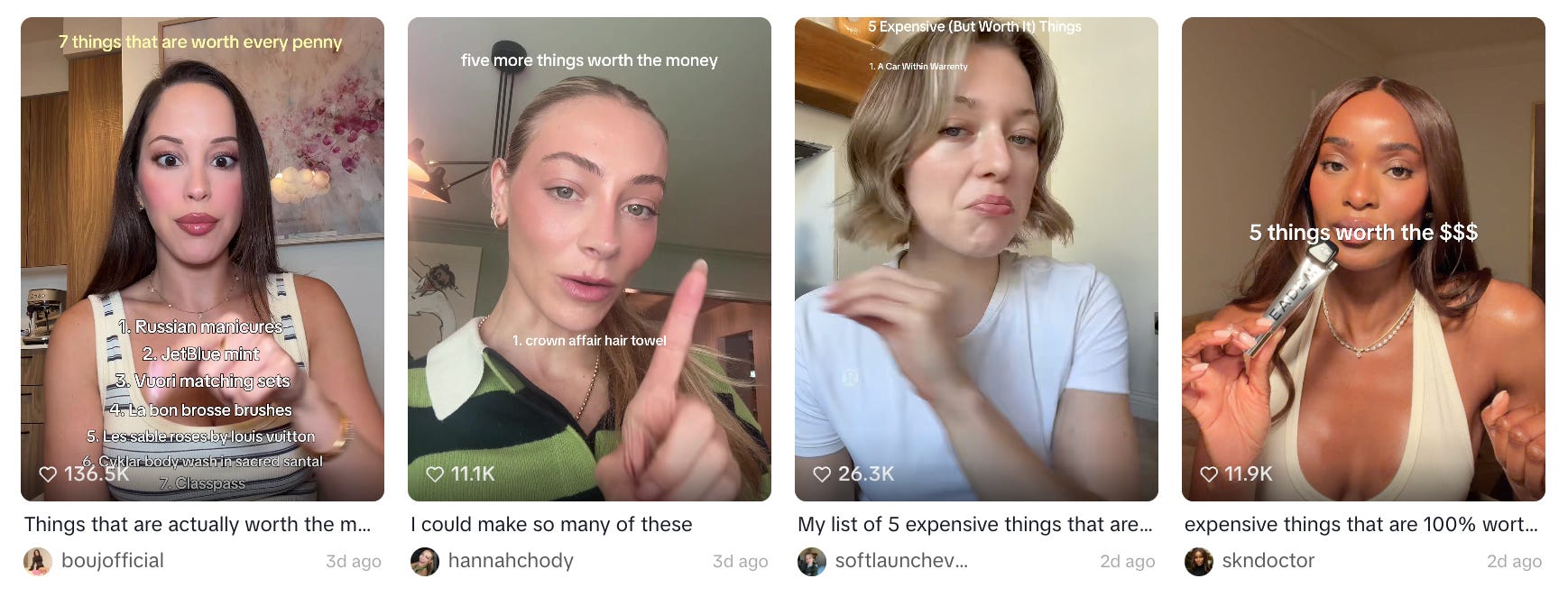
My personal opinion is that watching these videos are useless in terms of real high ROI spend. It’s another way to be influenced to buy, instead of challenging your desires and consumption habits.
Most people spend their entire lives spending on things that cost so much in time and energy. And to be honest, these videos are another way to signal status, as most of them include designer/branded items and experiences. They put the personal in personal finance, and are absolutely not guides on how to spend your money. Even so, they’re fun to watch, as per any and all Hot Girl Propaganda™ content.
So instead of letting a stranger’s content strategy decide what’s worth your money, let’s build you a way to work it out yourself.
The cost of a thing is the amount of what I will call life which is required to be exchanged for it, immediately or in the long run.
Henry David Thoreau
𝜗ৎ In this issue:
What a purchase actually costs
Calculating a what a high return is a Financial Hottie
The Financial Hot Girl’s high-ROI spending matrix
How to map your high-ROI spends to your financial season
The exact audit to run on your spending
What I’m actually spending on for a high ROI

What a purchase actually costs
Your life. Over 150 years ago Henry David Thoreau essentially wrote that the real cost of a purchase is the hours of your finite life you handed over to earn it. The most Financially Hot sentence in the history of personal finance.
Your health. A second currency every financial hottie feels; the hours you spent earning that money costed something physically, too. The stress of the deadline that funded it, or the sleep you didn’t get. The body keeps the financial score, and there’s a record in there somewhere for every impulse purchase you made to get a little dopamine hit.
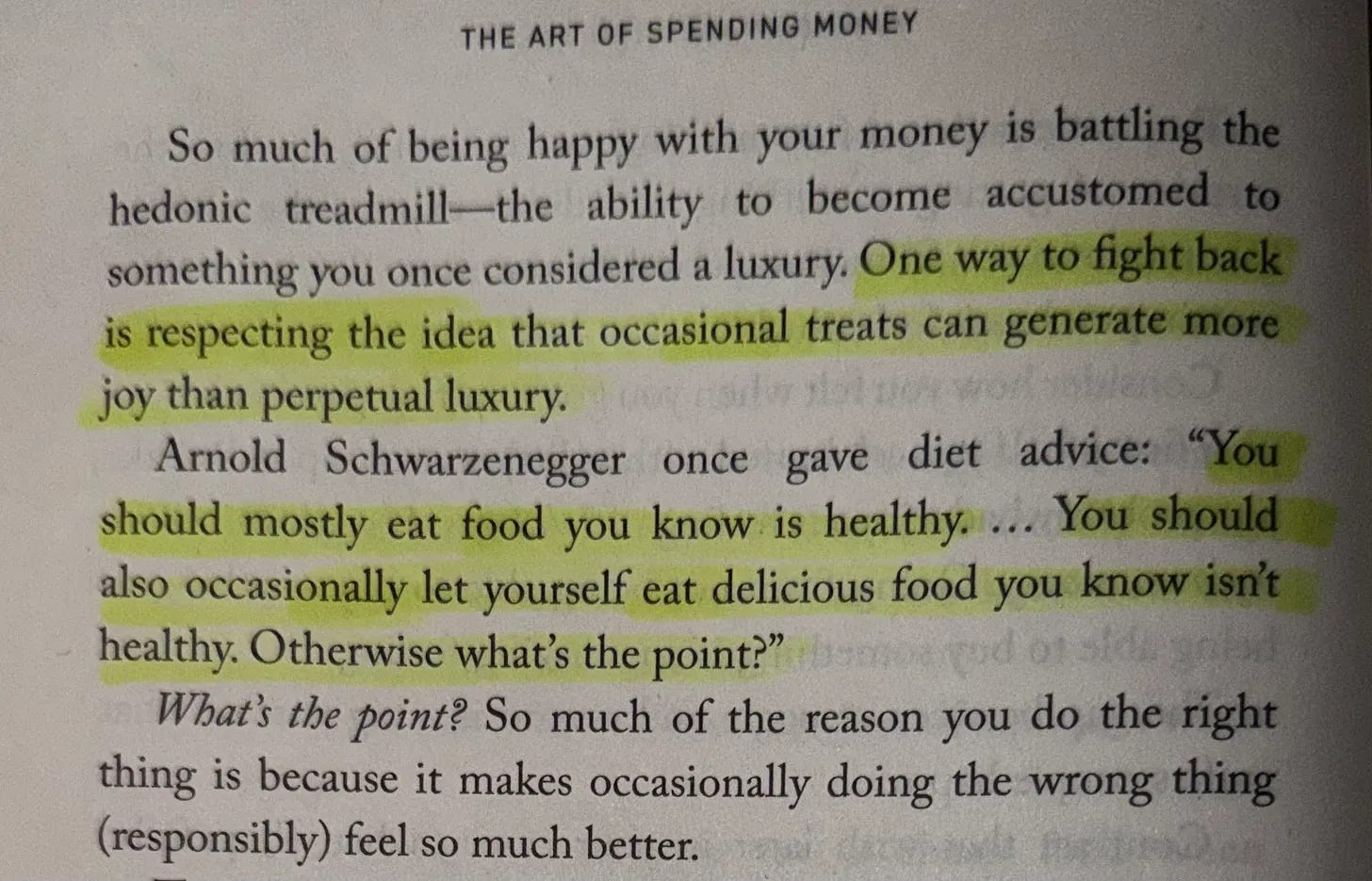
Your joy. Speaking of dopamine, there’s also the cost of hedonic adaptation. It’s when the rush of dopamine you feel after consistent spending gets duller and duller, but the numerical spending stays the same. Hence why the odd splurge feels worth it and the daily one doesn’t. Making that feeling scarce is what keeps the cost of something in line with the feeling of buying it.
Calculating a high-ROI spend as a Financial Hot Girl
Every spend has a return (positive or negative). Sometimes the return is:
Financial: you maintain, make or get more money because of it—exercising the principle of leverage. E.g. investing £50 in the stock market to get back much more than £50 25 years down the line. Or spending money to outsource a task in your business to get back more time (to then make more money).
Operational: it gives you back time or energy. With physical health being the basis of being a Financial Hot Girl, you’re spending money to maximise your mood, your earning potential, your longevity and your independence
Compounding: it improves how you think, earn, sleep or perform, which touches every other area of your life (i.e. it lets you leverage something)
A status return: people perceive you as a certain kind of person because of it, which could allow you to access certain rooms or conversations. Spending with this in mind rather than the status itself is how you use status as a tool to level up.
Remember these could all be negative i.e. take away energy/money/time/status too.
But the reason it’s hard for you to determine what a good ROI is that you don’t actually know the value of your time. Lucky for you, it’s easy to work out.
Start with two numbers:
Your current rate. Net monthly income ÷ hours actually worked (be honest about the evenings and weekends)
Your aspirational rate. The rate you'd need to earn to hit the income you actually want, rounded up*
Example: you’re on £36,000 and you work a normal 9-5, and the odd evening. That’s ~£2,450 a month working 50 hours a week. 2,450 ÷ 200 = £12.50 an hour.
Now imagine you’re debating a £90 air fryer versus a £90 moisturiser. That’s 432 minutes of your life, or 7.2 hours. Instead of focussing on whether you can afford £90, think about whether the purchase is worth 7.2 hours of your time.
*A big gap between current and aspirational is a good hint that you’re in your earn season. Now let’s figure out how to calculate your return.
How to define a high-ROI purchase
Once you know your hourly rate, a purchase earns the high-ROI label if it gives you back more than you put in, measured in productivity, health or time, and if the return survives the initial pleasure spike. So let’s move onto the next equation.
The implementation section of this issue is for paid financial hotties. I’m walking through:
how to calculate your specific return-on-investment based on your current rate
how to map your high-ROI spends to your earn/keep/grow financial season
the exact audit to run on your spending
exactly what I’m investing into
What I’m actually spending on for a high ROI
For a bit of transparency, my highest-ROI spends thus far have been:
My travel around Latin America, a considered investment in life, memory and identity
A private member’s club in Edinburgh
Books, always books—and strictly fiction over self-help—on my Kindle
Software that gives me back time: Wispr flow, CleanMyMac, Claude, Canva Pro, Notion, NordVPN
Padel and Spanish lessons
My walking treadmill + standing desk
Used iPhone, used Macbook
Sony A7c ii and my Sigma 16mm lens (for both content and hobby)
Phillips air fryer, Ninja Creami
Something I’m in the process of setting up: my online security with software and a YubiKey. Will update you on this once I’ve figured it out.
Remember: a high-ROI spend doesn’t have to be an expensive purchase, it just has to be something you might not have otherwise bought had it not been for you being clear on intentionality and your life values. Affordability is not the point when it comes to what’s “worth it”.
Until next time,
— Dev xo
The example comparing a £90 purchase to 7.2 hours of work is particularly useful because it shifts decision-making from affordability to opportunity cost, a core principle in economics.
Research in behavioral economics also suggests that people tend to derive more lasting satisfaction from purchases that enhance capabilities or experiences than from consumption driven primarily by status.
The article’s focus on operational and compounding returns reflects the concept of capital assets: investments in health, skills, or time-saving tools can generate benefits repeatedly rather than being consumed once.