

you might be in the wrong financial season
are good decisions made at the wrong time still good decisions? | fhg #81
Stop asking “is this smart?” Start asking “is this my financial season?” We’ve already determined that decision-making is a key financial skill. But how do we make good money decisions, especially when personal finance advice is anything but cookie cutter?

Happy Sunday, financial hotties. The biggest thing blocking most of us is not knowing how to move forward: staying stuck in that paralysed state of knowing all too much and doing all too little.
For whatever reason we may be stuck there, the most helpful antidote is a structure to uphold a good decision. Something that makes you feel less like you’re just picking a decision out of thin air and hoping for the best.
I remember all too well my first few years at corporate: I was earning very little, looking up at this metaphorical wall of milestones to come. Buying a house, getting married, and finally looking up what investing was. And the only thing I could think of was: “well how in the heck am I going to afford to do all of that on my measly £20,000 salary”.
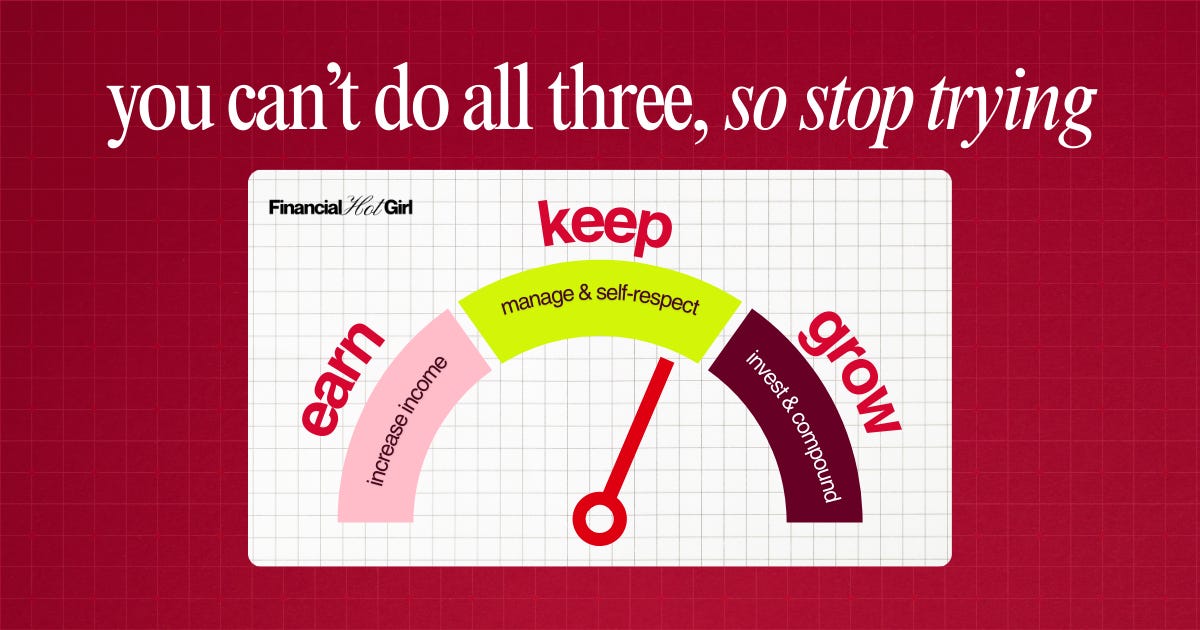
The thing I didn’t quite realise back then was that life is very much seasonal, and I had only just entered my financial season to earn. That’s where the Earn, Keep, Grow© model comes in.
𝜗ৎ In this issue:
What is Earn, Keep, Grow
How to know your financial season
The exact moves for each financial season
The seasonal trap to avoid like the plague

Financial literacy is seasonal
Financial literacy is very seasonal, and I know this because even since becoming financially literate, I have still made mistakes. And that’s because personal finance isn’t one size fits all: it’s possible that you can optimise too hard, play it safe for too long, or invest too early (yup).
That’s why I invented the seasonal Earn, Keep, Grow© model behind the Financial Hot Girl methodology. It helps you place yourself in a financial season, and understand that a decision made now doesn’t take away from a decision you can make later on. It allows you to understand fully the opportunity costs that may or may not be on the table, and the priorities to you and your life at any given time, based on your goals and ambitions.
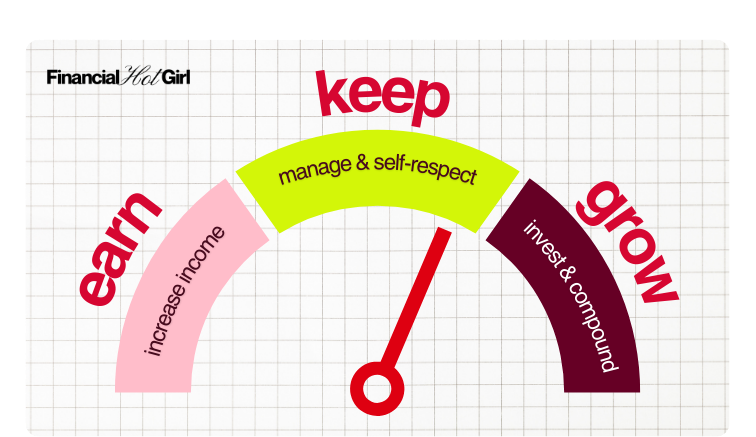
Having and adopting a seasonal mentality to your finances then allows you to stop putting displaced pressure and/or responsibilities on yourself:
Thinking you need to invest while you still have debt
Over-optimising your spending when it’s time to start investing
Earning more at the cost of future growth (risking burnout)
Without the ‘right timing’ mindset that a seasonal mentality gives you, financial literacy can feel full of friction (the wrong kind—in this year of friction-maxxing).
How to know your financial season
In my opinion, a core pre-requisite for determining your financial season is understanding your goals in life. Do you want to retire early? Start a business? Start a family? Because, you are only ever in one season at any given time. And that’s largely because of human psychology: you physically cannot give 100% to more than one focus at any given time. So while it might feel efficient to try and optimise two financial seasons at once, doing so sabotages any chance of success with both the financial seasons and the goals.
Given that you are always primarily in one financial season, here’s how to determine which is for you (at this moment). Think about these factors against your goals:
Earn: your income is your main constraint. You feel stretched month to month, despite reeling in your spending. You can’t meaningfully save. You feel like you have to rely on overdrafts, credit or other buffers.
Keep: your income is sufficient, but savings don’t reflect that. Earning your income doesn’t burn you out. You have lifestyle creep. You feel out of control. You know you leak money but you can’t quite put your finger on why.
Grow: you have a surplus after expenses. You have a safety buffer. You’re not relying on debt. You know you can make your previous financial seasons work harder. You don’t leak money. All of your energy does not go to earning or keeping your money.
As a quick filter to understand what financial season you may be in, ask yourself these questions.
If my income doubled tomorrow, would my current problems disappear?
→ You’re in Earn.
If I managed what I already make better, would everything feel a bit less like throwing spaghetti at the wall?
→ You’re in Keep.If I don’t invest now, will I regret wasted time?
→ You’re in Grow.
The exact moves for each financial season
꩜ Earn: your job is expansion.
Your only job here is to raise two things: your income floor and ceiling.
This means that you prioritise:
Negotiating pay upwards
Applying for better roles
Up-skilling with ROI in mind
Starting small income experiments
Building high-value skills
And that you deprioritise:
Aggressive investing
Over-optimising expenses that make up <1-2% of your income (e.g. £20-£50 expenses on a £25,000 salary)
Lifestyle upgrades that lock in fixed costs
In an Earn season, your energy goes into earning capacity and earning potential. P.S. for more on earning and building leverage:

꩜ Keep season: your job is control.
Your only job here is to stop the leaks and build stability with your own finances.
Things to prioritise:
Tracking spending properly
Building a 3–6 month buffer
Paying off high-interest debt
Automating savings
Reducing fixed costs that suffocate you
Spending less than you earn, repeatedly
What to deprioritise:
Chasing more income for ego (it will end up leaking out)
Jumping into complex investments
Ignoring your numbers because it feels uncomfortable
Keep is self-respect in practice, because most of the Keep related behaviours revolve around intentional behaviour—and intentional behaviour revolves around a strong sense of self and discipline toward your goals.
꩜ Grow season: your job is leverage.
Your only job here is to turn surplus into assets.
Things to prioritise:
Consistent investing
Pension contributions
Equity and ownership
Reinvesting in scalable systems
Playing long games
What to deprioritise:
Hoarding cash out of fear
Micromanaging tiny expenses
Staying in Keep forever
Grow is where time becomes your partner.
The seasonal trap to avoid like the plague
Some of you reading this might see a seasonal mentality as a trap because you might look at a Grow season as one for status, or feel avoidant around the Earn season because of sunk cost or it feeling risky. You might also want to stay in Keep forever because control, naturally, feels very safe. These things happen when you don’t have a) goals and b) a financial identity.
Your identity and your goals come down to who you are at your core. For example, if you don’t really trust yourself, have no clear goals and lack confidence, you could end up trapped in Keep, never leveraging your money, or Earn, trying to burn out earning the most for no real reason.
I made this mistake myself. Before leaving my corporate job, I didn’t believe I could be an entrepreneur. So instead of fully committing to my Earn season and increasing my income or building runway intentionally, I focused on investing aggressively as a 9-5er trying to retire early. I was technically in a Grow season on paper. I had surplus, and I was investing. I was “doing the right things”. But I wasn’t building toward the life I actually wanted.
Had I been clearer on my identity and had more self-trust, I would have optimised my Earn season properly. I would have pushed harder on income and built a bigger runway to leave corporate earlier, instead of over-optimising Keep behaviours and quietly coasting into Grow while feeling deeply misaligned.
But what I’m here to remind you is that you don’t stay in one financial season forever, by definition of the fact it’s a season. I have moved back into my Earn season, to earn at a higher level, and I’ll move into Grow when the time is right, having had a successful Keep season a few years ago.
And that’s the beauty of financial seasons—you cycle through them. Earn creates surplus, Keep protects it and Grow multiplies it. Then if you want, you Earn again at a higher level and jump straight back to Grow.

The goal here is aligning yourself with a financial season and giving it 100%, knowing it will carry you through to the next.
It facilitates a) having the confidence to make decisions and b) actually following-through on those decisions, creating the financial momentum you need to actually hit your goals.
I hope this helped create a lightbulb moment for you in how you can frame your financial decisions this year—and let me know, what financial season do you think you’re in, and why?
See you next week,
— Dev xo
I love this model! Makes so much sense to have one focus at a time. I'm in my Grow season. I earn enough, and I know how to manage my funds, but I need to keep learning how to grow what I have earned.
the payment method is an issue