

the art of the unmonetised hobby
what cool, rich and it girls actually have in common | fhg #90
I’m writing this from a café in Argentina with a half-edited photo of a street dog on my phone that nobody is going to see. I’ve been taking photos obsessively for the last few months of travelling through Latin America; not for any reason other than loving the way a good photo feels to take.
During this trip, I’ve booked padel lessons I’m not good at, signed up for multiple weeks of lessons in Spanish I am definitely not getting paid to learn, and been on multiple hikes where I took no content. They’re probably the most Financially Hot things I’ve done all quarter.
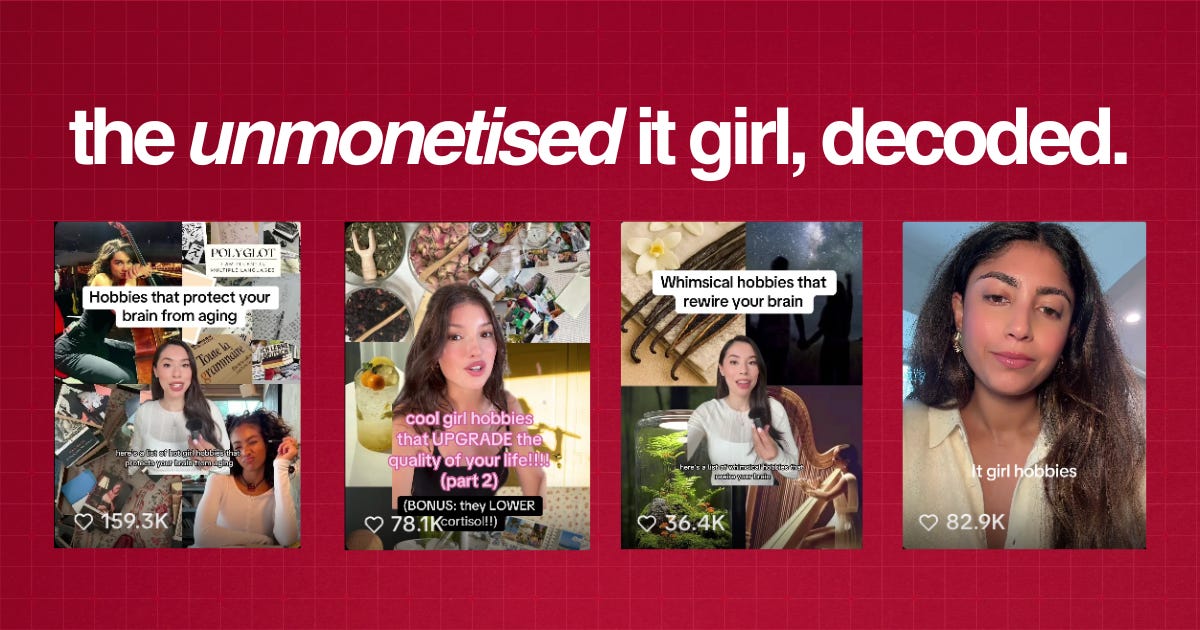
I’ve been thinking about this a lot lately, because there’s content doing the rounds online: the wealthier you are, the weirder your offline life is. The cooler your hobbies, the richer you are. Rich people do the most random things: fencing, falconry, rare book collecting, birdwatching, competitive chess. And I’m noticing it online like it’s a lifestyle tip: pick up an obscure hobby…and you’ll become rich/cool/[insert IT girl adjective here]!
But in my opinion, this take is getting the causality completely backwards. The obscure hobby isn’t the cause of the wealth. The kind of person who cultivates a life full of obscure hobbies is also the kind of person who builds wealth, because the traits required to do both are the same.
So this issue is about how to become that person, but on purpose.
𝜗ৎ In this issue:
the burden of monetisation
the traits a weird hobby actually builds
the links between unmonetised hobbies and wealth you didn’t realise
how to craft a wonderfully weird offline life

the burden of monetisation
Somewhere around 2019/2020, we somehow decided that every hobby needed a revenue stream. You don’t just like baking, you have a sourdough account. You don’t just run, you’re training for a marathon with a sponsorship and a full production crew.
The second you monetise something, it stops being a hobby. It becomes a job. Labour. Something you could potentially resent one day. I know this, because it’s happened to me multiple times. As soon as I put too many rules and regulations around something, friction enters the chat.
There’s actual research on this and it’s called the over-justification effect. When you give someone an external reward for something they already enjoyed intrinsically, their intrinsic motivation drops. It’s like taxing the joy out of it.
So the popular advice — monetise everything you love! — destroys the thing in you that actually builds wealth: your ability to do something consistently for no reason other than you like it. Which, tied back to our money, is the same ability required to invest money for 30 years and not touch it.

the traits a hobby actually builds
I think a lot of people get this wrong in the ‘get a hobby’ content I see online. A cool girl, weird, unmonetised hobby builds the exact psychological stack that wealthy people have. It has nothing to do with the specific hobby, but the doing of it which then rehearses these traits:
Tolerance for slow reward. Learning Spanish is boring for 18 months before it’s fun. So is investing. So is building a brand. So is literally anything that compounds.
Being okay with being bad, or stupid at first. I was terrible at padel. I keep going anyway. This is the same muscle as starting to invest with £50 when the internet is pressuring you to have a £100k portfolio by 30.
Comfort in your own company. A hobby requires sitting with yourself. So does money. People who can’t be alone tend spend to escape.
Process over outcome. You don’t hike to get to the top. You hike because the walk is the beautiful thing. This is the single most underrated financial skill.

the links between unmonetised hobbies and wealth
I took a long, hard look at my hobbies and why I think they’re the key for a life full of wealth. These are the actual mechanisms by which an unmonetised hobby makes you richer.
1. Energy arbitrage. This is the one I feel in my feelings the absolute most. My photography/videography, running, padel and language learning make me better at my actual job. I come back to the income-generating work with something to give. Burnt-out people make terrible financial decisions — there’s well-documented research on decision fatigue, and it affects everything from spending to investing to whether you negotiate a pay rise or not.
2. The anti-dopamine economy. We are drowning in short-form, fast-reward content. Your brain gets trained to expect everything now. Slow hobbies retrain the exact neural pathway that investing (and a financially disciplined life in general) requires. You cannot hold an index fund for 20 years if you can’t sit through a 10-minute walk, in my opinion.
3. Your social layer changes. In my case, my network could include hiking groups, run clubs, language exchanges, padel leagues. You meet interesting people without an ‘official’ transaction involved. Sociologist Mark Granovetter wrote a famous paper in 1973 called The Strength of Weak Ties — most career opportunities and life-altering introductions come not from close friends, but from acquaintances. Hobbies manufacture weak ties, but at scale, without effort, and with fun.
4. Lifestyle ceiling drops. When your joy comes from a 6am run or a £4 library book, your spending baseline naturally just drops. You’re able to keep more of what you spend, without trying.
5. Identity-first wealth. Morgan Housel’s whole argument in The Psychology of Money (a Financial Hot Girl staple) is that wealth is more about behaviour than smarts. A weird hobby is a signal — to you, and to everyone else — that you’re the kind of person who does things on their own terms. For you, and not anyone else. Financial confidence follows the same identity.
6. You stop copying. Hobbies pull you out of mimetic desire and more into yourself. When you’re obsessed with getting better at your own thing, you care less about what everyone else is buying, wearing, posting, therefore you spend less trying to ‘fit in’.
crafting a wonderfully weird offline life
I think you engineer a life with cool hobbies instead of trying to find a perfectly-cool-enough one to pick up. Here’s how I think about it:
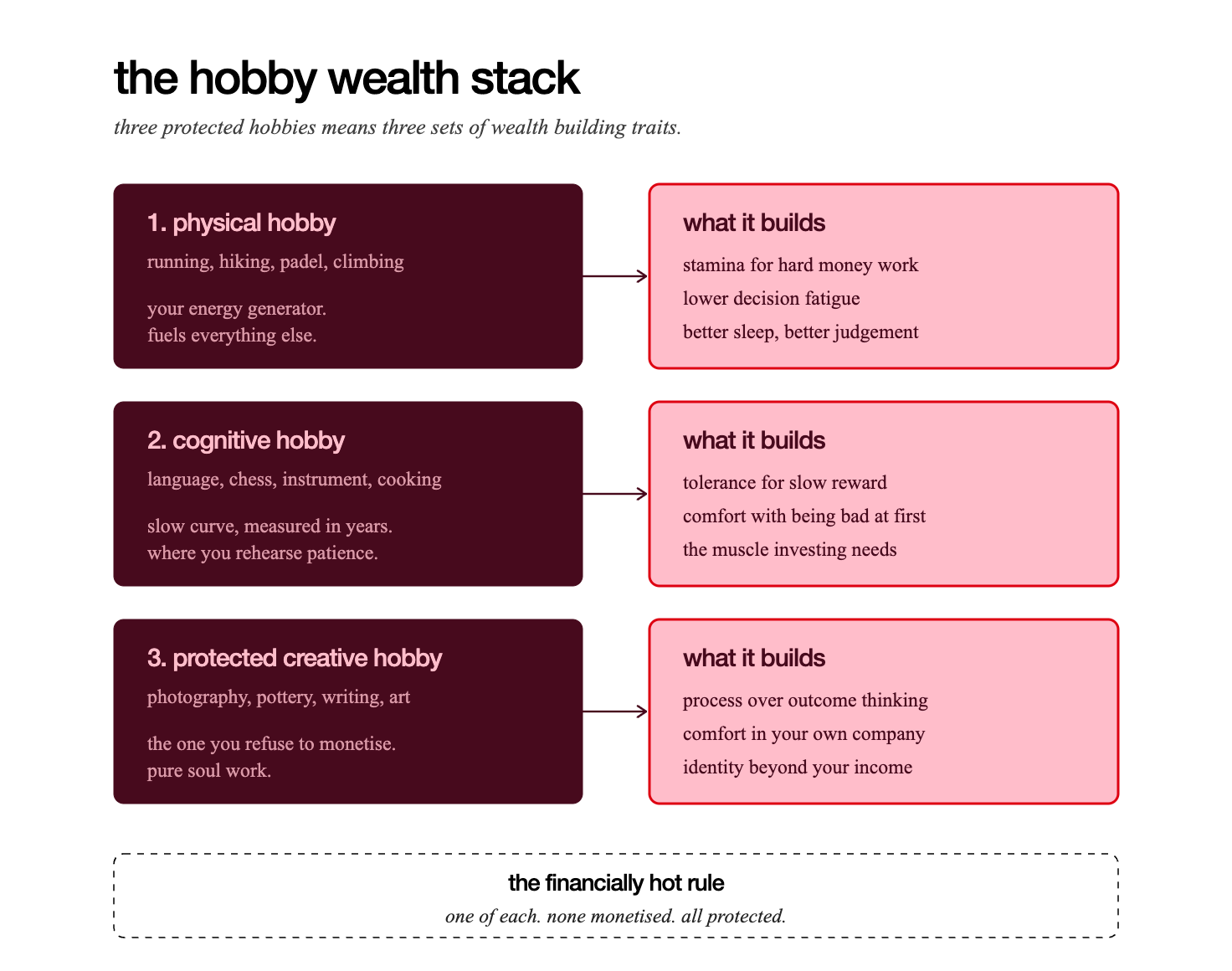
Pick one hobby you’re genuinely curious about and protect it from monetisation. For me it’s photography and padel. I don’t really post the photos I love most (if I do, it’s as a personal note). If you need to, make it literally impossible to monetise. Pick pottery, not pottery-TikTok.
Pick one physical hobby that gets you outside. Running, hiking, padel, climbing, anything. This is your energy generator. You’re doing it because it’s the input to everything else — it helps you become a better version of you.
Pick one cognitive hobby that has a slow curve. Language learning, chess, a musical instrument, learning to cook properly. Something where you have to measure progress in years, not weeks. This is where you rehearse patience, discipline and delayed gratification (two key skills of financial literacy).
Stop explaining what you’re doing to other people! The second you start narrating a hobby to everyone, you’ve started doing it as a performance and it’s not for yourself anymore. Shut up and just do it (please).
Separate the money work from the soul work. My business makes money. My hobbies make me. I need me to make money. Conflating the two is how most creators burn out and most professionals lose themselves, speaking from experience.
The Financial Hot Girl will not read this and start googling ‘weird but cool hobbies’. Take note!
Follow your natural curiosity. Calendarise a Daily Stupid Hour and learn a new skill. Craft a life where you become the kind of person who has a few, protected, slightly strange things you do just because they’re yours, and they’re fun.
Ironically, you can’t learn this as a wealth strategy and there probably isn’t a course on it. You kind of just have to be interested enough to do it yourself.
Until next week,
— Dev xo
this week’s comment prompts 💬 (bringing this back from the OG newsletter days!)
What’s your initial gut reaction to having a Daily Stupid Hour?
What’s a hobby you’ve secretly wanted to pick up but felt too old/late/silly for?
What’s the ‘weirdest’ hobby of someone you know who’s got their life together?
Daily Stupid Hour makes me feel smart. Time well spent.
I want to pick up sewing! I think it's an important skill - I love clothes and would LOVE to be able to tailor my own to fit me properly (looking at you, cute pants that are WAY too long)!