

you can refuse the upgrade treadmill and still be ambitious
big dreams are not the enemy of enough | fhg #101

Approximately three years ago, one of my “I’ve made it” goals was to buy a Birkin in a specific colour and size to use as my main bag.
I thought it would be the marker of my success, my freedom, my optionality. The kind of thing the women I admired seemed to have, so naturally, I assumed I should want it too.
I now think this was absolutely ludicrous of me, but for quite rational reasons.
Aside from realising it was mimetic desire showing up, I actually hate having to carry a bag (it’s one area of life in which I’m extremely jealous of men and wallet culture). Despite this however, I’m a crazy bag lady. I have pouches for everything and don’t like leaving the house empty handed (how very Virgo big sister of me).
Now, this contradiction told on me a little. You can be perfectly self-aware, and still attach a huge amount of meaning to something that doesn’t actually make sense for your life. My milestone Birkin stood in for freedom when what it really represented was a desire to belong. Snap.
Some of us do want more than the average lifestyle. Some of us are building lives that are meant to feel exceptional. Some of us want beauty, wealth, range, elegance, impact, room to move, room to choose, room to change our minds.
So how do you know when a goal actually supports your life, instead of just being a beautiful symbol you’ve mistaken for a need? How can high-achieving people separate expansion from escapism and status-signalling?
𝜗ৎ In this issue:
Dealing with the rising price of success
A scorecard to figure out the goals worth keeping
The diminishing returns of status
Questions to define a different ambition

✦ The rising price of success
Part of what makes this conversation hard to define is that the cultural baseline keeps moving. Gen Z is apparently imagining that financial success means hundreds of thousands a year, even before they have the life, stability, or peace that money is supposed to buy.
The cost of living keeps rising too, which means people are being asked to pay more for less certainty and less breathing room. People want more because inherently, everything costs more and it’s only getting worse.
When life costs more, it becomes harder to tell the difference between a desire rooted in wisdom versus panic. And in this panic, it’s easier to want to signal wealth. Even celebrities do it.
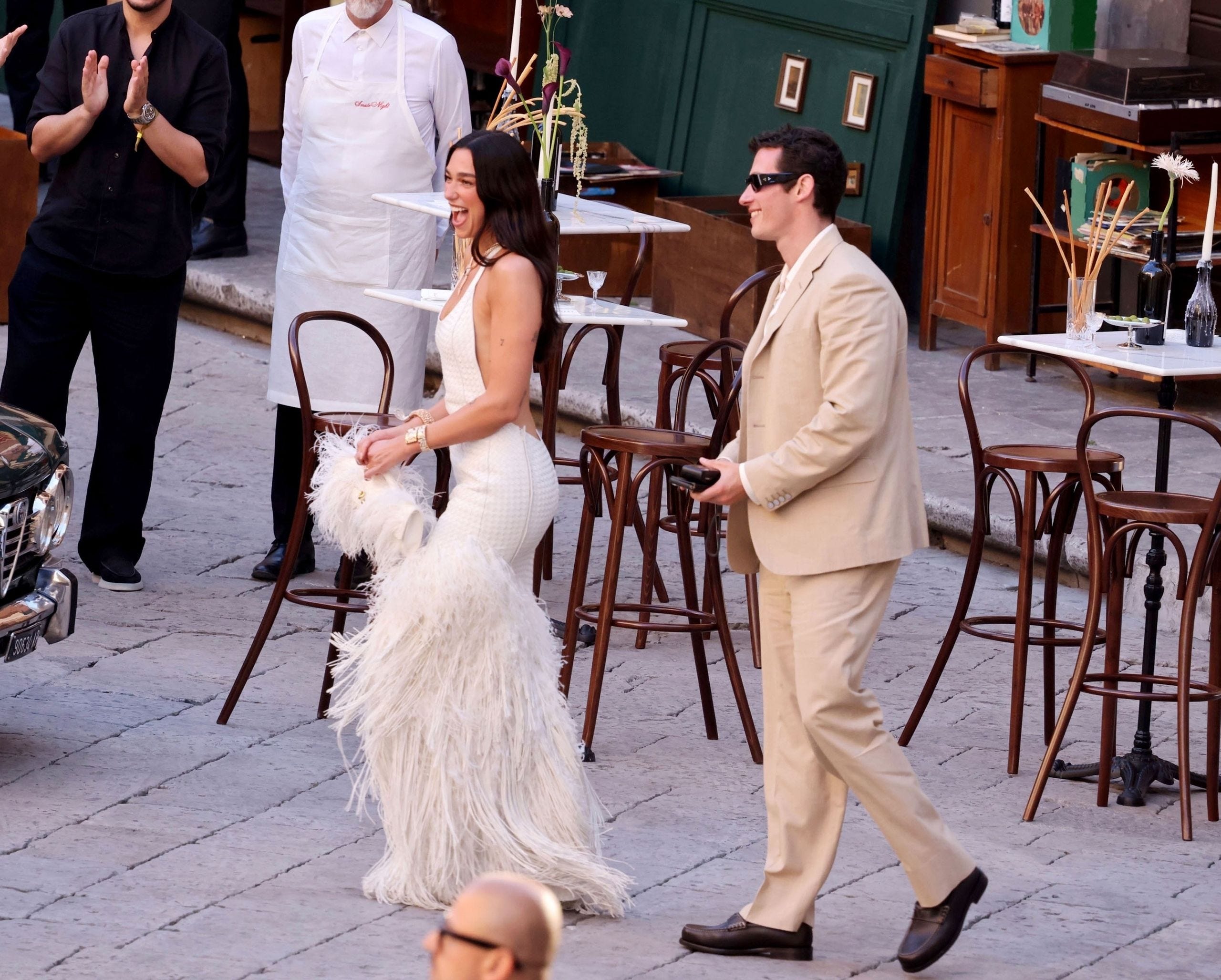
Take recent big-name weddings. Dua Lipa got married and it became a stream of labels, settings, and iconic fashion moments: Schiaparelli, Bottega Veneta, Chloé, Chanel, a civil ceremony in London, then broader wedding celebrations in Sicily.
It is glamorous and probably spectacular in person. But it captures how quickly a milestone can become a production, where every feeling has to be translated into a designer, a location, a look, a reveal.
Then there’s the opposite fantasy: Zendaya and Tom Holland, whose marriage drew attention because it was so incredibly withheld. It suggested to me that a milestone event can still be real, meaningful, and complete without becoming content, and that enough looks different even for those who can have anything they want.
Both women can quite literally afford whatever version they want. Even at their level, the choice still exists: enough is a decision instead being of a milestone income bracket. And if the two most-watched women of the year can arrive at completely different versions of the same event, the pressure you're feeling to inflate your own goals is worth questioning too.
⟡ The goals worth keeping and how to find them
To fight through the rising price of success, we need to shift our perspective inward to our own personal values. We need to ask whether the big goal deserves the level of devotion we’ve prescribed in the first place. So we’ve got a little scorecard to work through.
Audit each of your goals before investing too much time, money, or energy. Score each question with a number between 1-5, then total the number:
Meaning: does this deepen my life, work, or relationships?
Values: does it align with what I actually care about?
Freedom: does it increase optionality, or just create upkeep?
Energy: does it energise me, or subtly drain me?
Durability: will I still care about this in three years?
Craft: does it sharpen a skill or capacity that matters?
Cost: what does it ask of me financially, emotionally, and physically?
Signal: do I want the thing, or the identity attached to the thing?
Enough: can I define what a satisfying version of this looks like?
With this scorecard, you can make two conclusions. A high-scoring goal tends to give something back in the texture of your real life. It increases freedom, capability, pleasure, or peace. A low-scoring goal usually depends on an audience, even if that audience is imaginary.
A goal can be chic, expensive, widely admired, and completely wrong for you. Avoid this trap.
✦ The diminishing returns of status
Next, we need to work out how we use status strategically to set our goals.
Status-based goal setting has a point of failure because status gives you an emotional return early on. Things like your first pay-rise or the first big spend on a holiday. After that, each additional layer costs more (money, time or energy) while delivering less emotionally than that first, and that is the logic of diminishing returns.
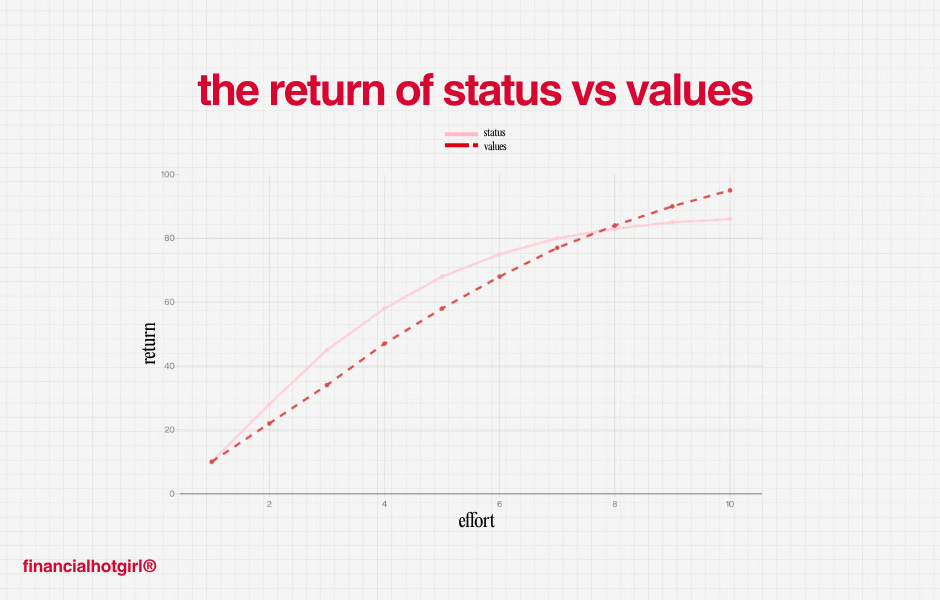
A values-based life however, feels slower at the beginning because more effort is spent planting seeds: of skill, trust, health, reputation or relationships, all of which start to flourish over time. And these remain useful for longer, because they increase your capacity to feel deeply gratified instead of just feeling a pang of “okay great now it looks like I’m doing well”.
With this in mind, point your goals at the value (skills, relationships, capacity, networks) that often sits underneath the status and then let the status follow. Do things for the value and let status be a by-product that just happens to be there.
Status matters, because social signalling affects success, confidence, opportunity, and how people are read in the world. Similarly to how you look. The problems will start for you if you start using it as a way to operate instead of the clever tool that it is.
⟡ Questions to define a different ambition
To find your enough (without shrinking your audacious dreams and goals) ask yourself:
What am I hoping this goal will make me feel?
Is there a lower-cost, lower-noise way to create that feeling?
If nobody could see this, would I still want it?
Does this goal increase my freedom after I achieve it, or only my upkeep?
What would “enough” look like before the chase begins?
These questions force you to be clear without taking away from the fact that you don’t want an average life. As Financial Hot Girls world we’re not interested in encouraging each other to stay average, but we’re also not interested in inflating our lives for anyone but ourselves.
All in all, the answer to finding enough is to become more exact and look inward rather than shrinking anything, which is the pressure I’ve felt while reflecting on this question myself.
Big dreams are not the enemy of enough. You can want an extraordinary life and still refuse the upgrade treadmill. A person can love beauty without worshipping labels, build wealth without making wealth the only scoreboard, and celebrate milestones without turning every success into a spectacle.
Until next week,
— Dev xo