

5 irreversible shifts to transform your mental, physical and financial habits
the ideas I wish someone had handed me at 22. | fhg #106
Welcome, financial hottie. You’re reading a Hot List, because if there’s one thing an FHG binges, that’s a damn good list. Whether it’s financial habits, workout spots in Mexico City or the best places to find ice-cream in Edinburgh, there will always be a list you can’t miss. If you’d like to manage what parts of FHG you read, you can opt in or out in your subscription settings.
Happy Sunday, financial hotties. Thank you for all the love after last week’s newsletter, some of you went out of your way to send some very kind emails and I couldn’t get over how lucky I am to have such benevolent internet friends 💌


This week I’m sharing with you a few concepts that transformed my 20s. I didn’t discover these things at once, or out of a ‘need’ to fix something. In fact, in my 20s, I was so obsessed with self-improvement content (books, mainly) that I’ve come across these things in different forms at different times. They all apply to mental, physical and financial habits, whether in isolation or in a way that created a domino effect whereby I changed a thinking pattern → my financial habits improved as a result.
And for things like this—mental models, ways to think about life, ways to structure self-betterment—they won’t click until you’re in the right spot in life to allow them to click. I’m here to introduce you to them so you reach that spot quicker <3

The Diderot effect. Lifestyle creep but make it astronomically worse. Relevant to hotties in their Keep season, it’s the vicious cyclical mechanism behind lifestyle creep at a very micro level; new trainers “need” new gym kit, or a nice sofa making the rest of the room look wrong. One small purchase becomes the first domino in a whole new spending category. When something new makes what you already own look wrong, notice that nothing you own actually changed. The cascade is a status upgrade you accidentally opted into at the point of purchase, and the cheapest place to stop it is at that first item rather than at item four, once the standard has already been set. Ask yourself what the first purchase really means; what you’re trying to signal and whether you could buy it without telling the world about it.

Hyperbolic discounting. The annoying, surreptitious cousin of delayed gratification, a financial hottie’s best friend. Putting energy toward a distant goal feels harder than resisting a small reward right now, since the brain overvalues short-term rewards and underestimates long-term pain. Hyperbolic discounting is why willpower is not a personal failing, a huge relief for overthinking go-getting financial hotties. Instead, use a Naval’s decision compass above to avoid hyperbolic discounting: choose the more difficult path ahead—this automatically makes your future easier. E.g. for financial habits, automate the transfer to savings or investments as soon as you’re paid, so that willpower isn’t required at the moment of temptation. Schedule the therapy session. Lift the weights. Prioritise future you, she’s worth it.
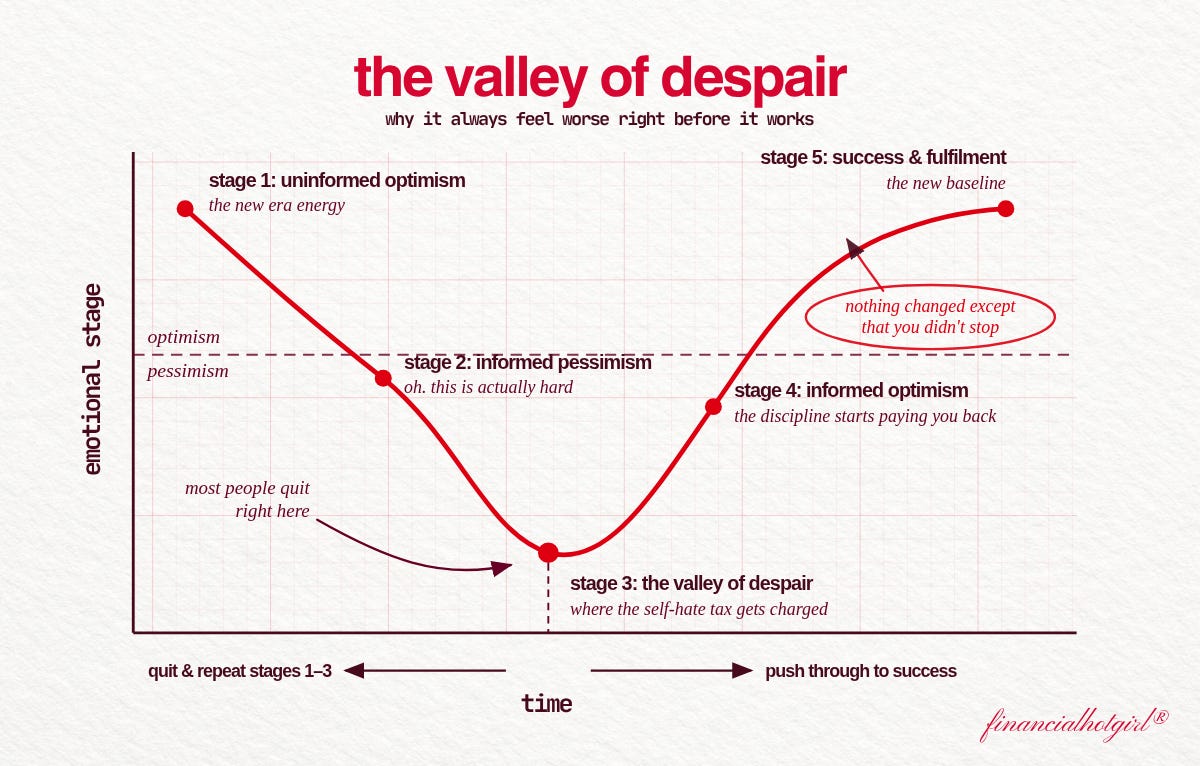
The valley of despair. Because financial hotties are usually working on mental, physical and financial change at once rather than picking one, you’re more likely to hit a dip in more than one area simultaneously, which can feel like everything is falling apart rather than one predictable stage of a [very] normal curve. It’s because we tend ot be informed pessimists by that point. The valley of despair is very normal, and thinking that there’s something wrong with you personally for ending up in it is how you end up paying the self-hate tax and getting stuck in your Keep season whilst you’re there. How to get through it? Head down, keep going, avoid giving up.
The Zeigarnik effect. The low, dreadful background hum of anxiety from unfinished financial admin (unopened bills, unlogged expenses, the email from your accountant you procrastinate looking at). To be honest, this applies to all admin, but financial admin causes nervous system disruption. Zeigarnik and this irksome effect is why teeny, tiny undone tasks feel disproportionately heavy. The answer? Decide Once™ on a short, standing 30 minute slot every week to close the open loop of undone tasks and pair that slot with a reward to help yourself get through it. The mental noise stops when the decision is closed, which requires a short burst of focussed action. Watch this creator if you need to hype yourself into that action.
Self-perception theory. The exact words you use about money train your brain on who you are, and downstream of that is your financial behaviour. So much of the identity work in our twenties happens unconsciously, said out loud and in our heads a thousands of times before anyone notices the pattern. "Who am I to afford that" insidiously builds a story of powerlessness, while "that's not a priority right now" keeps the choice with nobody but yourself. This is the self-hate tax in its cheapest form, costing nothing to pay and everything to keep paying.
🗣️ Words are spells that influence your self-perception. Curate yours by reading this.
Uncovering the philosophies behind good and bad thinking patterns is the first step to actually putting change into action. So read this with a pinch of salt, and don’t force yourself to apply all the big philosophies to the way you live—but keep them tucked away in the back of your mind, ready to lean on when you need to.
Until next week,
— Dev xo