

you're too cool to let life just happen to you
stop letting low agency habits get the better of you | fhg #93
I am painfully Type A. Which means almost 7 months ago, there existed a perfect plan for how my Latin American backpacking trip would go. A budget, an itinerary (with sub-itineraries) and even a plan B. But then, life happened anyway. We’ve been stranded in Colombia amongst countless other things that went completely sideways.

If this had happened to me in my early 20s, I would have let it happen to me. I would have let it define me as unorganised, stupid, or a disaster of a traveller. But one of the best things that the development of my frontal lobe has given me is the understanding that failure is information. And the difference between someone who lets life happen to them and someone who navigates it with information is agency1.
Agency is the habit of treating a problem like it has an instruction manual. To me, it’s the opposite of having a ‘victim mindset’. And financially, to be more high agency, it’s worth avoiding three low agency traps.
𝜗ৎ In this issue:
The Perfect fantasy
Waiting to “feel better”
Over-identifying with one bad day
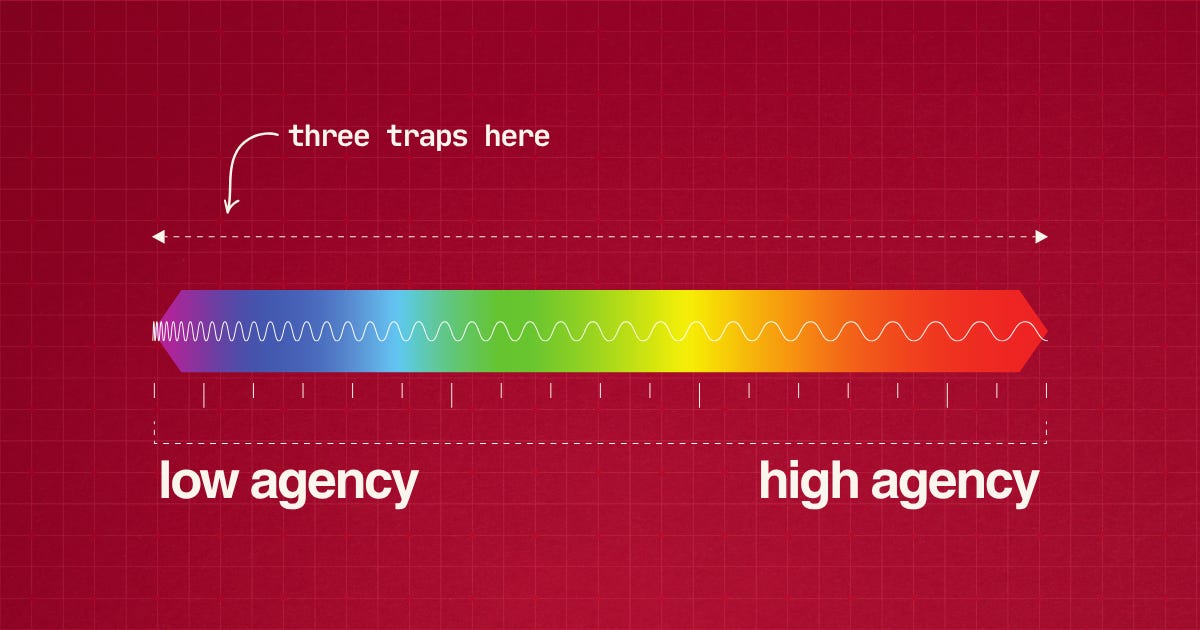
Important note: a high agency person is inherently trustworthy of themselves, and doesn’t have a scarcity mindset. They realise that even in the worst situations with the worst outcomes, they can recover from it, and that rock bottom means nothing other than having to go back up. That’s why they’re able to act, or move forward, despite an unfavourable situation.
I learned this from reflecting on all the situations I’ve faced in life, which I’ve come out the other end of, despite the anxiety/depression/financial-nothingness it gave me. This reflection has been tremendously influential in giving me a foundation for being high agency.

Trap 1: The Perfect fantasy
Have you ever heard the Woody Allen quote “If you want to make God laugh, then tell God your plans”? I think this also applies to money. Maybe even more so to money, because money hates perfection. And the moment I understood this, was also the moment I realised I wasn’t actually terrible at budgeting or unorganised with money, and that I could simply just change how I organised my money.
Logistically, it’s hard to plan for the unplannable. It’s hard to predict what will go wrong, but equally, you can’t plan for things to go wrong and manifest failure. But financially, the thing to do here is to not let the ‘wrong’ or ‘unpredictable’ happenings be the main plot-line of your life. Especially if you’re in your Earn/Keep season!
Low agency says: “Well, I didn’t stick to the budget because of [insert unplanned event here], so the budget is ruined. Therefore I suck at finances and only bad things happen to me.”
High agency says: “The plan met my reality. What did I not account for? Let’s change things.”
Despite things going wrong, the most useful question you can ask yourself financially is:
What is the smallest version of this I can still do today, despite what ‘went wrong’?
Minimum viable financial behaviour that can be done in the midst of whatever life throws at you is the goal. Like logging into your bank app instead of tracking your transactions because you don’t have the time or energy. The problem with the minimum viable behaviour is that it feels embarrassingly sloppy, pointless, almost cringey in how little difference it could make. But sloppy and pointless gets you further than not doing it unsloppily.
Even how I used to budget for my social life a few years ago was sloppy—I wasn’t getting a spreadsheet out and forcing myself to stick to a figure. I knew I had drinks coming up with a friend, but I also knew that I wanted to max my investments that year. So I transferred myself an approximate amount for 2 drinks and a sweet treat on a specific card I used for ‘fun’ spending, told my friend up front that I couldn’t stay too late, and accepted that I adjusted the plan for my ‘imperfect’ life.
Trap 2: Waiting to “feel better”
Grow season hotties, this trap is sticky for you. Telling myself that I’ll do it later when I feel more motivated, or better, was one of my most unhelpful thinking patterns in my 20s. It cost me a lot financially, because this is the exact thinking that stopped me from investing back then.
And therein lies the irony. It’s often that the feeling we’re waiting for is hiding behind the action we’re avoiding. Like when I felt financially more ready once I’d opened an investing account that I didn’t even put any money in.
Think about how often you’ve said things like:
“I’ll sort out my investments when I’m less stressed in a month”
“I’ll negotiate my salary when I feel more confident”
“I’ll check my subscriptions when I have a free afternoon next week”
Low agency here is waiting around for that feeling, which in all honesty may or may not ever arrive.
A high agency mindset here is understanding that motivation follows action, and not the other way around. And financially, this carries so much more weight. It’s why I sometimes think that once you reads a finance book or find a podcast you finally get—you don’t stop your personal finance journey2, because something finally clicked.
The feeling you’re so desperate for is on the other side of that tiny3 task you’re avoiding. So just do it.
Trap 3: Over-identifying with one bad day
This is the trap that causes the most damage because we really often tie our ‘failures’ directly to our self-worth, especially if you already struggle to feel worthy without external influences.
I skipped the gym = I’m undisciplined
I overspent = I’m bad with money
I didn’t read = I’m stupid/never follow through
Low agency turns behaviour into a complete character assassination assessment. But per the Financial Hot Girl micro-philosophy; we use ‘failure’ as data.
High agency behaviour after a bad day is reflecting on it. Your ‘worst’ financial decisions very rarely exist in a vacuum. Your ‘worst’ days are likely to coexist with your ‘worst’ financial decisions. Impulsive spending, financial procrastination, aggressively ignoring banking app notifications will never happen on your best days. Ask yourself what else was going on that day/month? Stress, exhaustion, loneliness, your luteal phase?
All of the data from a terrible day can be used to shape a better tomorrow, only if you let it. Bad days are not evidence of who you are as a person, how smart you are, or how financially capable you are.
Money-related things you’ve negatively characterised yourself for, have nothing to do with your actual character. Something happened in your life that’s leading you (unfairly might I add) to these conclusions—and that’s all it is. An annoying, yet correctable thinking pattern.
Because truly:
Understanding the economy is as simple as picking up a book.
Investing is as simple as…investing the money. There is no ‘too late’ or ‘too little’. There is your timeline and a few clicks on your computer.
If you find yourself reading this and thinking “well it’s not that simple, Dev” I challenge you to think more high agency. Things may not be simple in life, but the step 1.1 of doing something likely is.

The common thread across all three traps is this: low agency makes everything feel personal. A missed habit, the overspending, the plan that fell apart, but none of it is a verdict on who you are. It's just information. Start using this information, and stop weaponising it.
If you’ve read this far (a real one ❤️🔥) I think about high agency as the thing that will carry me through whatever I'm not prepared for yet. Grief and trauma have already proven to me that I can get through the unsurvivable. If I can do that, I can handle a any financial situation life throws at me. Believing you are not the product of what’s happened to you, plus action, is all high agency really is.
Until next week,
— Dev xo
As someone with an ‘everything is figureoutable’ mindset, an essay that gave me a lot of validation in my 20s was High Agency by George Mack. George is a writer I’ve followed for a long time, please read this essay today!
This is not to say money is non-linear, it definitely is, but you’re far more likely to keep pushing toward a financial goal once you’ve taken initial action on it.
Christi Newrutzen’s entire brand is about sloppy action and exposing how little time it takes to do the things we often procrastinate. Watch her for some high agency inspo.
Since the past few days, I have been stuck in this loop of thinking everybody's ahead, how everybody has their stuff managed and here I am, clueless, confused, scared. And then I came across this article and the perspective shift has been significant. Understanding low agency and it's impact somewhere cleared some of my doubts and I feel more and more people should know about how simply changing your perspective over any problem can help you view it as a challenge and not a threat and can help get through it while holding yourself accountable for the progress and not the actual problem.
Insightful article 🙌 I have fallen into these traps many times; action is what always brings me back. Maybe reading more about it will help cement those habits, definitely checking George Mack's essay.