

you're too cool to need so much stuff
why is needing a man embarrassing, but needing stuff isn't? | fhg #76
Happy Sunday financial hotties. This week I was editing a vlog to post on TikTok, when I noticed myself trying to pick clips where it didn’t look like I was wearing the same outfit repeatedly.
Except, I am wearing the same outfits repeatedly. I’m on a 6 month voyage around Latin America, and I spent the entirety of last summer (and autumn) decluttering my belongings ahead of this trip. Less stuff and less outfits was very intentional. That pang of shame I felt while trying to make a ‘varied’ selection of clips for my vlog was an old feeling, but one that it seems I haven’t quite exterminated. The feeling of “will people think I’m poor, unfashionable or not a financial hottie?” for wearing the same clothes.
The irony is I’m a very proud outfit repeater. On socials I share a lot about the pieces I love and rewear, and I’m proud to do so. It reduces my decision fatigue and gives me a lot of financial flexibility, yet the reflex to edit around my outfit repetition still came up. Because repeating outfits still carries meaning online, especially when the outfits aren’t themselves highly curated or expensive.
I realised this was not about my clothes at all but about how the desire to improve how things look can persist, even when you are technically consuming less.
𝜗ৎ In this issue:
Underconsumption is masking the point we’re missing
Owning less is not the same as needing less
How to actually start needing less
Things that feed your internal demand for more
Underconsumption is masking the point we’re missing
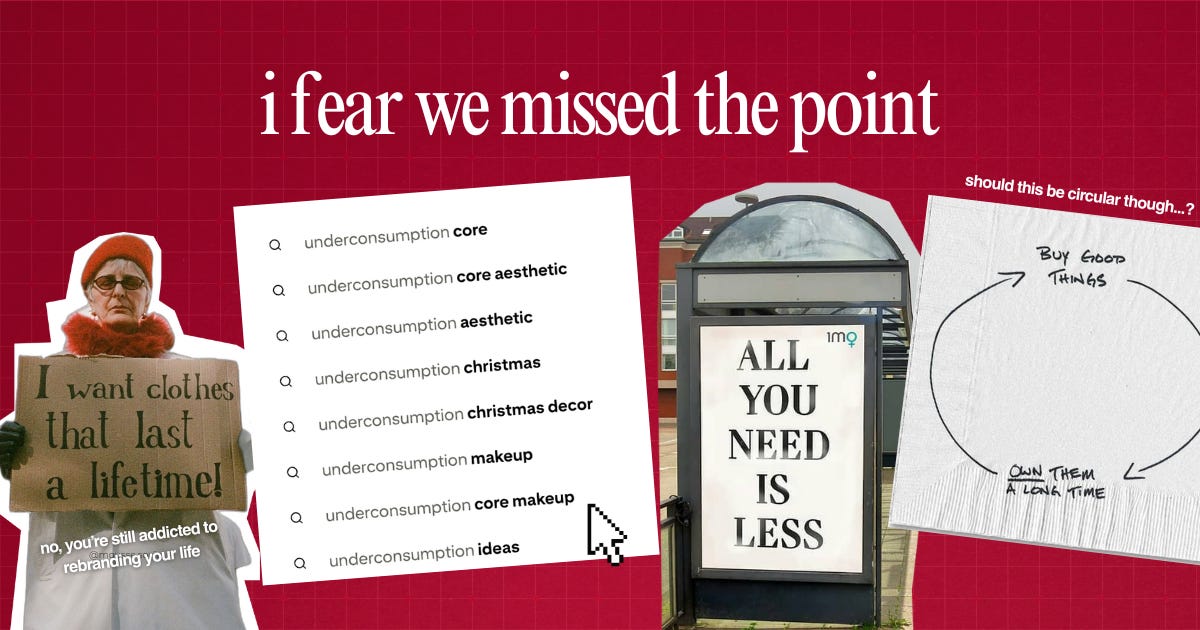
I’m no stranger to underconsumption—last year, it changed my relationship to myself and my home (my little flat in Edinburgh). Underconsumption is about using less, curating and focusing on what you already own by both repairing and reusing as much as possible. It’s something I love, and is ingrained in the culture I come from too. I shave my knitwear, I’ve been rewearing a Monki coat for almost 6 years, and I use Gü jars as jewellery pots. It’s normal behaviour for me.
Importantly though, underconsumption is not reserved for expensive, neutral, natural-fibre wardrobes. It’s not just another way to rebrand a new style. It’s literally underconsuming: going out into the world even if your clothes are old, synthetic, unfashionable, or bought years ago when your taste and budget looked different. Using what you already own, even when it does not match the current aesthetic of restraint.
But for some, it might be forced or a way to still signal wealth.
Owning less is not the same as needing less
There is a big difference between needing less and forcing yourself to use less.
Online, those two ideas get blurred. Forcing yourself to buy less still centres consumption, and I’ve noticed this a lot—especially around this time of year, when the motivation to do a ‘No Buy’ or a ‘Financial Fast’ is prime. There are rules, tracking, guilt and a lot of white-knuckling behaviour while your actual desire to consume stays unchanged.
It’s a lot like slapping a quick-fix diet on your life without addressing the underlying relationship to food and exercise. As soon as you stop the ‘diet’, you either revert back to your old habits or you live a live full of resistance. When you live a live of resistance you are constantly thinking about what you’re resisting. Whether it’s a diet, a budget or a desire to buy.
To change this, we have to work on inherently needing less. It shifts something more upstream inside us, where our urge to consume softens and consumption feels a lot less like a test of your character or your bank balance. It’s the unbothered feeling I now have when I wear clothes that aren’t necessarily cool or trending, because I know I feel comfortable in them and they accentuate features of myself that I like—I’m not trying to prove myself through my material items anymore. I have less to prove, therefore need less.
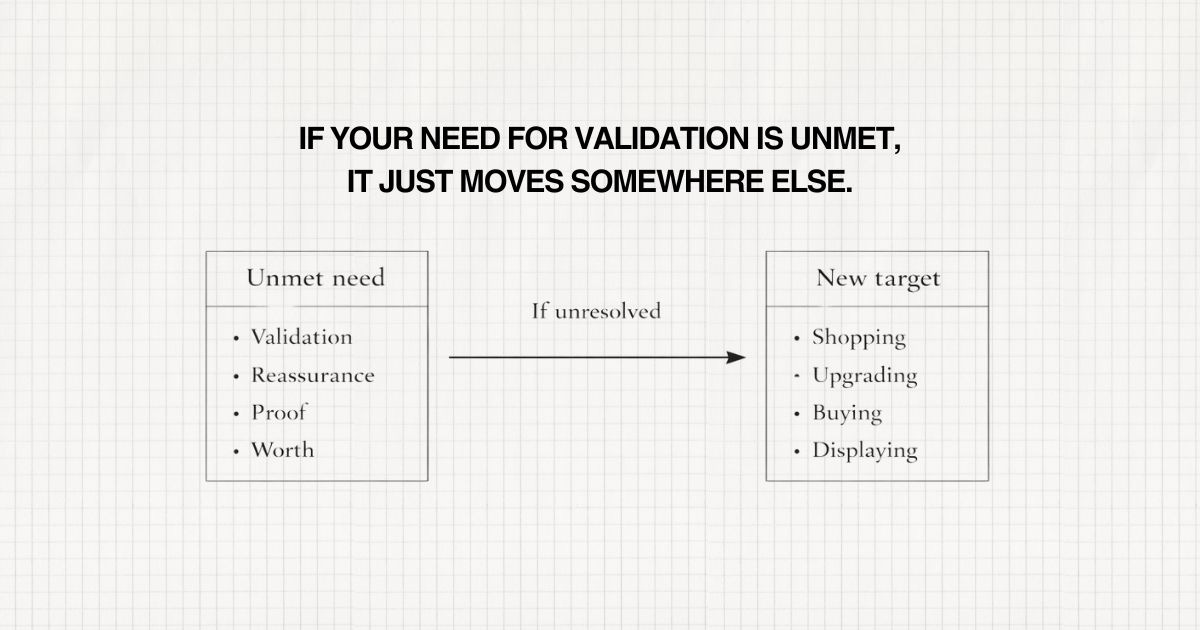
Culturally speaking, needing less can feel threatening because wanting things has become a form of social proof. Desire signals ambition, momentum, even relevance. New purchases show movement, that you can fulfil this arc of becoming a new you. But when the need, the desire, drops—those signals disappear, and without them, you worry about how you will be perceived.
Here’s another more confronting way to think about this. You would never accept being needy for a man, right? You would read that as insecure, misaligned, and draining to your sense of self-respect. Yet many of us stay needy for objects, upgrades, and purchases, using stuff to perform value and desirability. What exactly is it we’re trying to prove? And to who?
This week’s bonus issue is a direct way to combat your validation driven spending:

How to actually start needing less
The reason I used to need more revolved around how I valued myself. I talk a lot about my early 20s revolving around a desire for external validation and a need to fit in. I didn’t like how I looked for a long time. The way I then chased belonging showed up through spending, alongside other financially irresponsible decisions. I needed more in order to prove my worth.
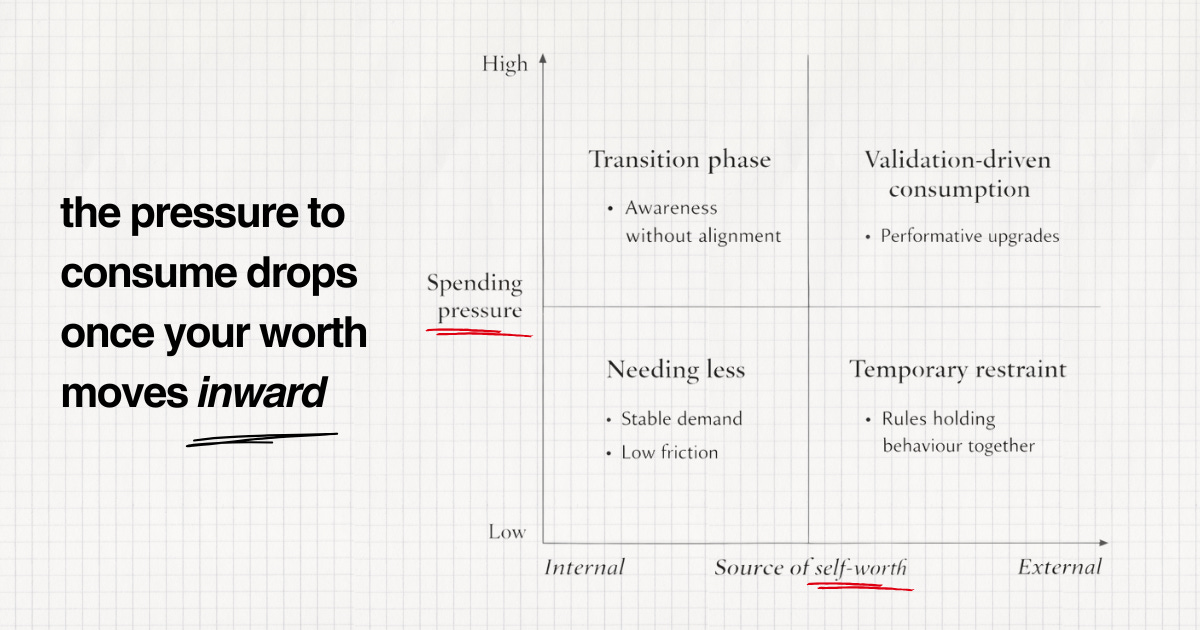
So what did I do about it? I (slowly, over 6 years) changed my markers of success and moved them inward, and focussed on my internal demand for needing things.
Things that feed your internal demand for more:
Constant online stimulation: scrolling, browsing, lifestyle comparisons, and hyper-personalised ads—exposure to these things create a need for more before you even realise it. Your inputs, especially online, reduce the chances of you even inventing reasons to need more stuff. We have all succumbed to this, and it’s important to curate it very intentionally. Personally, I am ruthless about how much fashion and home content I consume for this reason.
Unpredictable routines in life: chaos in life creates emotional gaps. I know this from experience (unfortunately). It comes down to the meals you prepare for yourself, the routines you perform all week—do you leave room for spending to enter the chat and ‘improve’ something you haven’t managed to control yet? The more choices you repeat in a day, the less room there is for something to feel novel and that it will magically regulate you. Decision fatigue is a gateway drug to spending away the stress of a chaotic day.
Your opinion of yourself: this sits under everything. If you value your life (and yourself!) based on how it looks, a desire to consume will always be alive. I’ve felt glimpses of that on this trip, and I remind myself of what I truly believe makes me feel full and happy—and that it’s not tied to how something looks—and my desire to consume immediately dissipates (another small reminder that your relationship to your worth is very non-linear). Once the ‘things’ in your life stop speaking on behalf of how cool, smart, hot or chic you are, your need to consume will hold a lot less power.
The power in mastering the art of needing less is that it will automatically make you consume less, and underconsumption will become your norm. There are a lot of downstream mental, physical and financial advantages to nailing your desire for more, so I highly encourage you to focus on that this year.
Remember: actually using what you have asks more of you. It asks you to sit with repetition without reframing it as chic. It asks you to stop upgrading your life visually before your finances catch up. It asks you to let things look ordinary.
Mindful consumption is not about curating a new version of yourself. It is about reducing demand and your need for things. Wearing the same clothes you already own. Using the items you already paid for. Letting value come from use rather than appearance.
Start with your self-worth. Ask yourself how much of your validation comes from the things you own. Be honest with your answer, and you will trigger the right change in your life this year.
—Dev xo
This is such an honest way to name it. Needing less rarely starts with budgets or rules, it starts with changing how we measure our own worth. When validation moves inward, consumption quiets down naturally. That shift takes time, but it is real, and it lasts.
this is so good. total perspective shift, I love the comparison of a quick fix diet that we are on for awhile but fall right back into old habits once we have met the goal. thank you for sharing, walking away asking new questions of my consumption.