

how to raise your financial IQ
what happens to your assets, your pension, and your career if things go wrong | fhg #96
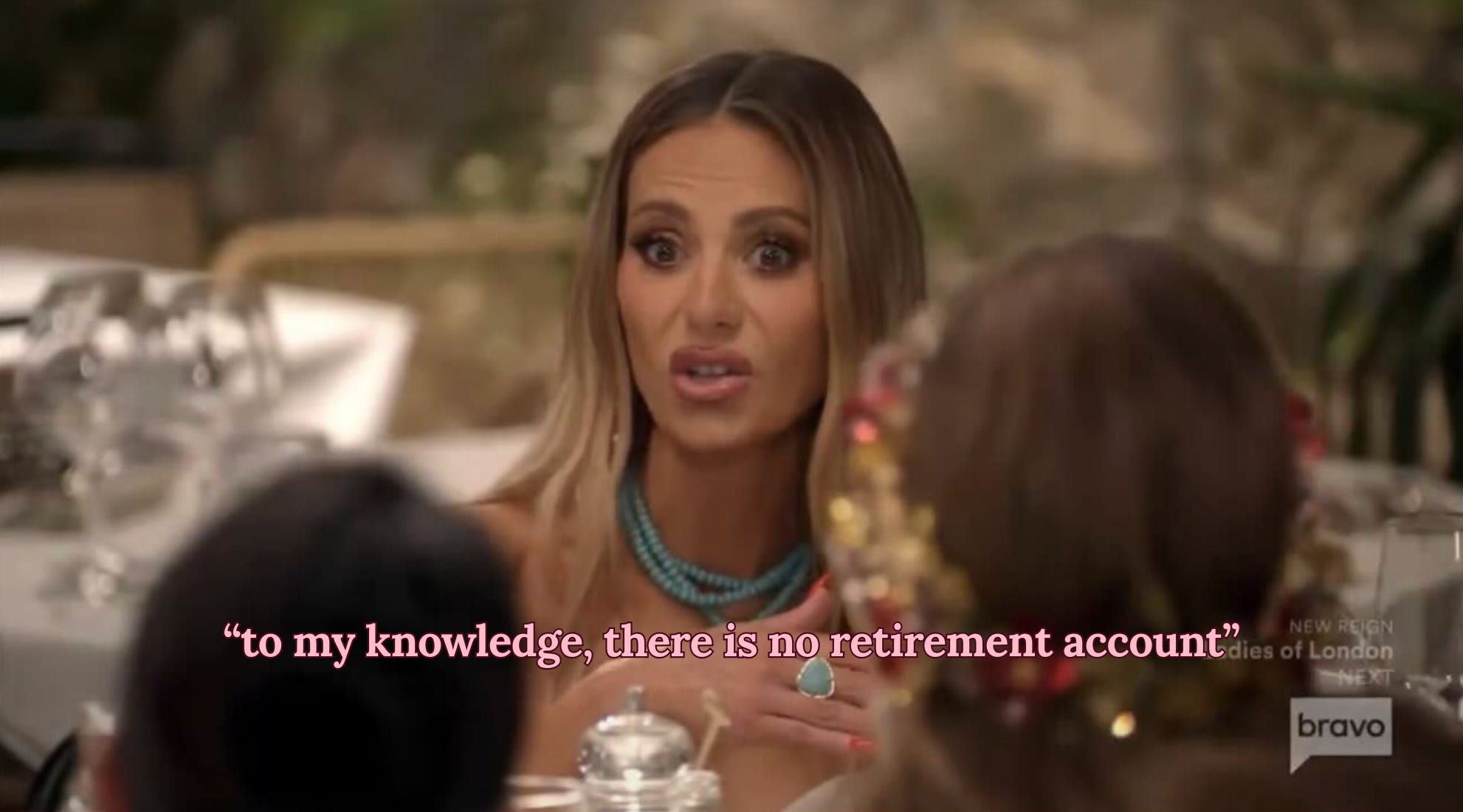
What really got me thinking about financial IQ is the current discourse around Belle Burden and her memoir Strangers—a memoir on separation and divorce, and the financial literacy of it all. On top of that, I caught an interesting conversation in The Real Housewives of Beverly Hills, where Dorit Kemsley—one of the housewives going through a divorce—was being questioned about how much she knew of her family financials, and she admitted to knowing nothing.
And I think raising our financial IQ is the answer, at least in part, to being able to have the worst in life happen to you but still be okay—at least financially. Because while I’m not yet married, or going through a tumultuous divorce, I would love nothing more than to avoid one ☝🏽
IQ: intelligence quotient. “A measure of your ability to learn and apply information”
Financial IQ: hereby defined as a measure of your ability to learn and apply financial information.
The word glowing on the screen for me is apply. Because a lot of us learn, and learn very well—all of you reading this are smart, and have no problems learning whatever it is you want to learn with the speed you desire. But applying that information is where we absolutely love to fall short.
𝜗ৎ In this issue:
3 essential concept to understand
How to apply it
A free resource for you 💌


✦ 3 essential concepts to understand
Financial transparency = relationship baseline
Dorit not knowing the details of her own household finances is an extremely common pattern, which tends to follow the same shape: one person in the relationship handles the money, the other person opts out, and it just works until it doesn’t.
Financial transparency in a relationship means knowing—at minimum—what comes in, what goes out, what you own, and what you owe.
It doesn’t mean you have to merge everything or give up financial independence (I’d argue you shouldn’t), but it does mean there should be no financial blind spots between you and your partner.
Not knowing your family’s financial position is the exact future liability you’re signing up for right now—and to put it in context, is the position that Dorit is likely in (again, I’m speculating as I know no details).
She has to now do lots of work, including potentially working with forensic accountants, to build a clear picture of her ex-husbands assets and family assets because she literally does not know and now, because of a soured relationship, cannot reliably find out herself.
Marriage legally changes your money (whether you plan for it or not)
Marriage is a legal and financial contract, and one that has real consequences you don’t get to opt out of just because you didn’t read the small print.
When you get married in the UK, a number of things change by default (there are many more, but here’s a few):
You become eligible for Marriage Allowance and assets transferred between spouses are generally exempt from Capital Gains Tax
You become each other’s default next of kin, which affects pension nominations, decisions made in hospital, and what happens to your assets if one of you dies without a will
If you only cohabitate and aren’t married, you have less of a standing to make any financial claims—especially dangerous if you stepped away from your career to caretake or raise children
Importantly, you’re in a weaker position if you just live together (within the context of having children, joint assets, and significant unpaid labour). But being financially literate means knowing which rules apply to your life before life applies them to you, on your behalf.
Stability and safety are not the same thing—one can disappear overnight
I’ve written about this before but it keeps coming back up, because it’s one of the most important distinctions in your financial life.
Stability is what you have when things are consistent and predictable, like shared rent, shared routines, a household that runs because two incomes are funding it.
Safety is what you have when you could leave, lose, or start over—and still be okay. Not comfortable, necessarily. But okay. Not in debt to cover your basic costs or in some way financially paralysed.
Stability can feel indistinguishable from safety right up until it isn’t. Dorit had stability. Chelsea Lazkani on Selling Sunset had stability. Belle Burden, by all accounts, had stability. The thing about depending on shared financial infrastructure is that it only works when the sharing (i.e. the structure) is intact. Safety is the thing that kicks in when the structure falls apart.
This whole thing isn’t about planning for divorce, or being unromantic, or assuming the worst of someone. Financial safety is yours to build, and yours alone—and it’s far easier to build it before you need it.

⟡ How to apply these concepts
Raising your financial IQ in a relationship context means knowing the above, then using it to have a real and out loud conversation with your partner, whether to review your finances together or just get some answers.
So reader, please know that as soon as finances started being discussed on the show, I slammed that pause button and turned to my boyfriend, ready to ask him 101 questions. Among those, I asked:
Should we get a prenup, or something drawn up that clearly defines separate vs jointly owned assets?
If something happened to one of us, like job loss, illness, anything—do we actually know enough about each other's finances to step in and manage it?
Have you nominated anyone on your pension? Because that doesn't automatically go to a spouse or partner—you have to actively sort it
How would we go about putting assets in our own name, if we’re building things individually—once we have children, will it ever be fair to do that?
If I stepped back from work to have children, what do you think would be fair in terms of how we'd manage money—and what I'd be owed if things didn't work out?
The key thing to note here is that watching the show was an especially convenient and useful launchpad for me to turn around and start this conversation without it feeling awkward or out of the blue.
Even while reading Strangers, Belle Burdens’ memoir, has been a great way to bring up certain topics that just wouldn’t come up naturally. I’ve had these conversations before, but it’s always fun to talk about. As a financial influencer and Financial Hot Girl however, the context is always there in my personal relationship to bring up money and finances—but for you reading this, having a conversational launchpad can help a lot.

꩜ The love and money conversation starter pack
Back when the love and money episode came out I created this conversation starter pack to help you discuss finances in your relationship—a starter pack in the sense that it helps you think about that launchpad and how to bring up certain topics, phrase them, and get a conversation started about them, before it’s too late.
I would love to know your thoughts on this topic—whether it’s conversations you’ve avoided or had—what are the things that worry you when it comes to relationships and money? Are you reading Strangers right now? Have you ever been shocked at the marital finances of these Beverley Hills women?
Until next week,
— Dev xo
The "what happens if it goes wrong" muscle is the one nobody trains us in, and it is the one I most want my kids to have. Teaching a kid to ask "and then what?" about a purchase or a plan is the whole skill. Cheaper to learn it at ten with allowance money than at forty with a mortgage.
Love the stability vs safety distinction.
I treat my wife as a true business and lifestyle partner.
Keeping our property, covered call ETFs, and VT completely transparent builds safety for both.