

being hot is a strategy, not a personality
on using your appearance strategically without overspending | fhg #78

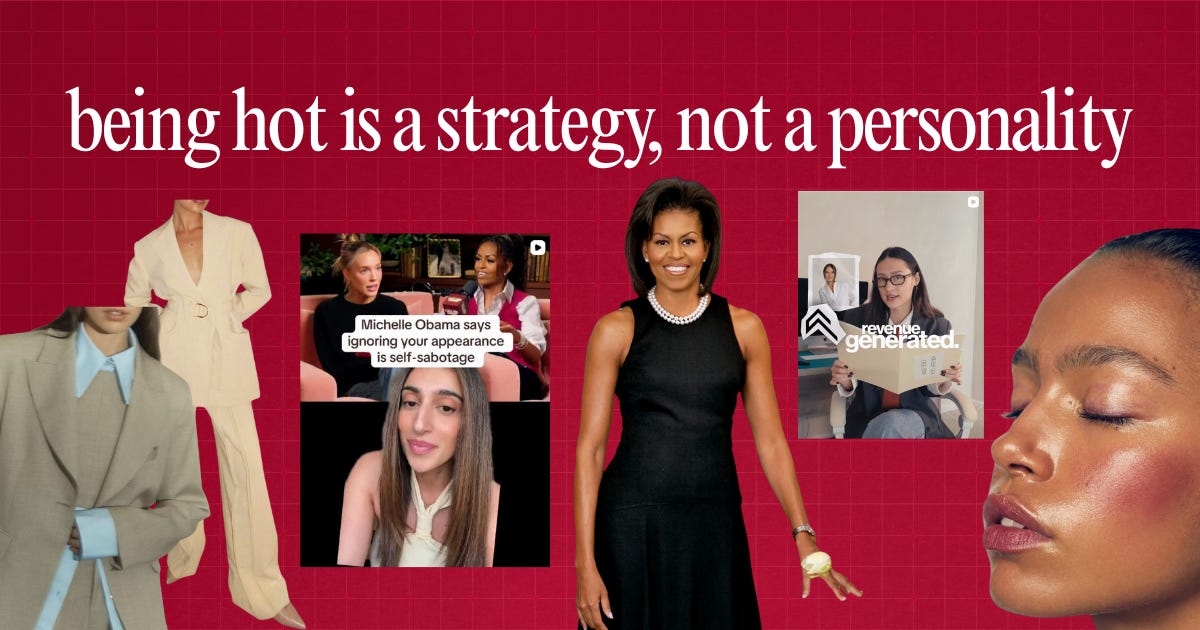
This week, Alex Cooper and Michelle Obama sat down for two hours and while they probably had a great time, I had the time of my life listening in. In particular, Michelle spoke about appearance as a strategy versus appearance as your identity. She spoke openly about how focusing on appearance was never optional for her, even with elite education, credentials, and institutional power behind her.
The unfortunate truth of it all is that no matter how credible you are, it will never neutralise the bias that exists in a culture that reduces women to their looks. So you either opt in and play the game, or opt out and get ignored. And in this issue, financial hotties—I want to talk about how you can opt in and invest in your appearance strategically without using it as an excuse to over-index and overspend on being hot.
𝜗ৎ In this issue:
The problem with turning success into a ‘look’
When being hot becomes unpaid labour
Leverage changes the rules of the game
3 ways to play the game without losing your money
There’s less than 24 hours left to uprgade your membership with the launch offer!
Here’s a summary of what launched to Close Friends last week.


The problem with turning success into a ‘look’
What Michelle was talking about in institutional power shows up very differently online, but it’s the same mechanism at work in my opinion: how success is portrayed online. Specifically, the sometimes performative female founder aesthetic. It’s a conversation that’s been on my mind a lot, especially after watching this from Nana DelRey:
Nana talks about how founder content rewards the polished look. One look at a Pinterest search for ‘founder aesthetic’ proves it. Having visual order somehow proves your competence online, and messiness just isn’t shown, even though it’s there. And the comments were full of female entrepreneurs singing in validation—people want to see the messy. Even I have deleted drafts and binned ideas because I didn’t look good enough to film them.
The issue underlying what Nana pointed out is that algorithms reward a good look. It then starts to feel wrong to build while looking ‘messy’. A good look then turns into a prerequisite for success (or looking successful). That’s when I think that ‘looking hot’ gets mistaken for progress instead of being the tool that it really should be.
When being hot becomes unpaid labour
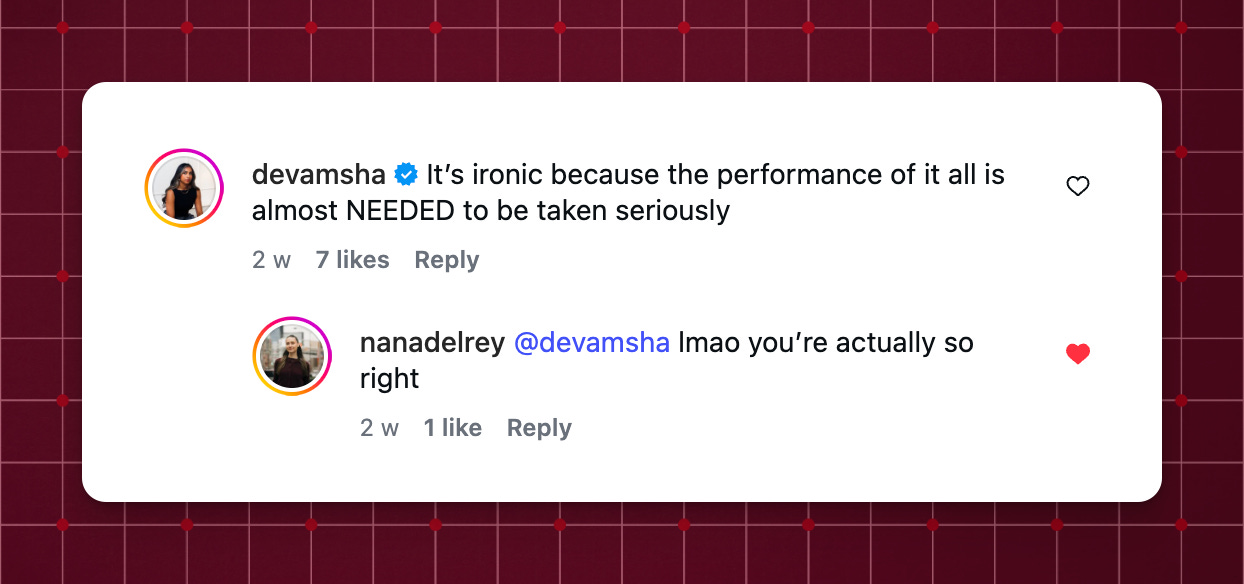
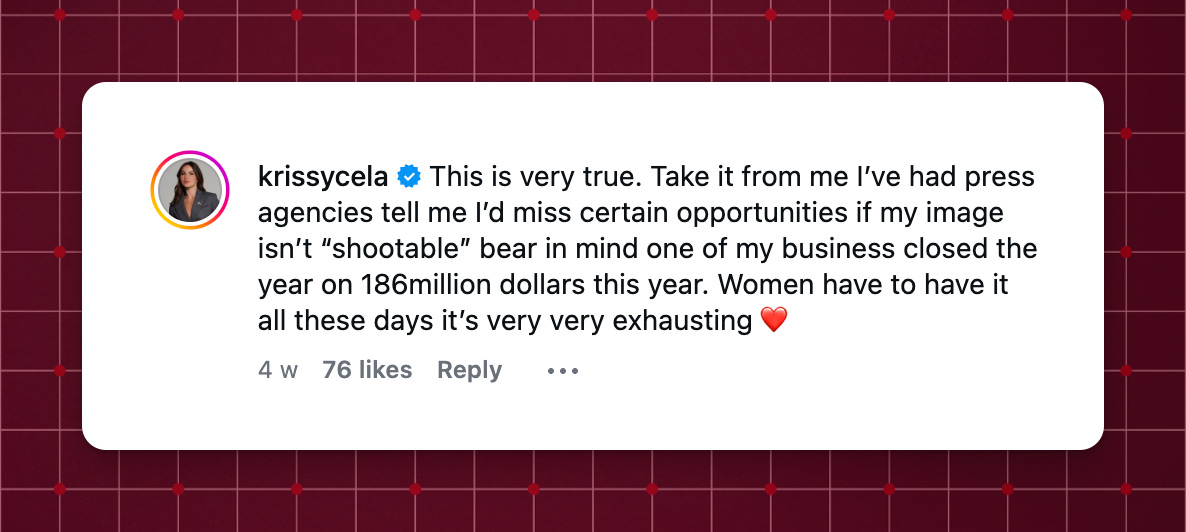
The salient thing here is the performance of it all. The performance—which inherently feels wrong because of how irrelevant your looks are to your worth—is necessary simply because of the infrastructure we live in. We [as women] are unfortunately building businesses in a world that ignores our competence until we’ve proved we look good enough, but equally not too good1.
There’s an added layer here for women of colour which often gets ignored in these conversations. Being “polished” or “professional” is still anchored to proximity to whiteness, whether that’s hair texture, skin colour, makeup, body type, or styling choices. Women of colour are often asked to spend more time, money, and energy to be read as hot, while simultaneously being penalised for appearing too visible or “trying too hard.”
Pretty privilege exists, but it is not evenly distributed, and neither is the margin for error. Strategic participation for women of colour often involves navigating a narrower path, where appearance can be used strategically without somehow erasing our identity. That tension makes leverage even more important, because the freedom to disengage from these expectations arrives later and at a higher cost for us.
Leverage changes the rules of the game
Like Michelle said in the Call Her Daddy episode, opting out doesn’t protect you from the system. Refusing to play the game is equal to playing a more difficult game. It’s a hard truth, and a frustrating one to accept. But you can’t dismantle the system without leveraging your way to the top, and this is where we make a crucial turning point: understanding how leverage plays into this.
Michelle spoke a lot about playing the game until you get to a point where your reputation precedes you. Opting in means choosing the path of least resistance: investing into your appearance as a strategy for growth, rather than an element of your identity.
Avni Barman speaks on it clearly here—you learn how the system works, play into it to your advantage, accumulate authority and selectively participate when the time is right. I didn’t understand any of this when I was early in my career, and it showed in how I tried to play both extremes.
Take my very first week in corporate as an example. I wore a full suit to the office because I was quite honestly excited to finally be working my dream big-girl job. I got laughed at by the male senior associates (note: they were also in suits). So in direct response to this reaction I toned it all the way down: jumpers and jeans everyday. I played both extremes and neither served me strategically.
The whole time, I was also straightening my naturally frizzy and curly hair to ‘keep it polished’. Avoiding no-makeup days because my hyperpigmentation can make me look tired on days I’m full of energy.
It’s a maze to navigate, but read the next section carefully and treat the game as a way to build leverage— this will free you when the time is right.
How to play the game without losing your money
As per the Financial Hot Girl motto, this is not a free pass to ramp up your maintenance routine costs in the name of entrepreneurial growth. This is a chance to review what spending will reduce friction in rooms you want access to.
Create a Personal Uniform™ and repeat it
Think about what ‘rooms’ you are in most often. In my life, it’s the gym, working at home, travelling, or remote meetings. What I’ve done is Decided Once (a FHG core principle) what 1-2 repeatable outfit formulas are for each room, and stopped thinking about what I’ll wear again.
At home, on filming days I wear my Skims black tee, loose black trousers and cashmere socks.
At the gym, I wear navy or black bottoms and one of my 2-in-1 bra tank tops. I also have gym specific socks meant for running/intense activity, and gym only trainers (old 9 year old trainers that have a flat sole for weightlifting).
Remote meetings or travelling, I wear an oversized blazer, my Skims tee again and suit pants and either boots or trainers.
For me I’m put together, deciding less, and consistently signalling what I want to signal in less time.
Define what ‘Put Together’ feels like for you
Something I’ve really learned from my 20s is that confidence usually comes from only one or two details, no matter how high maintenance you think you are.
Think about your beauty (skin, hair, body) or styling routines and:
Identify the features which significantly impact how you feel
Build your routine around those only
Stop fixing things nobody notices
Some of my personal examples:
Even skin instead of a full glam. I only apply makeup to areas of my face I consider ‘uneven’ and it’s cut my routine down by 15 minutes.
Controlled hair over perfect styling. I will quickly tong my hair in 10 minutes over attempting to achieve the perfect hairstyle that equally doesn’t erase my identity. It’s enough for me to feel put together.
Spend only where it reduces friction
Spend only after you have assessed the above two things in your life. For me, I’ve made a huge impact in my appearance and my spending by cutting routines to core products and only replacing things that work for me. I no longer purchase trends, ‘steps’ in a routine I don’t maintain, or brand upgrades that are superficial.
If it saves you time and energy, it’s entitled to be spent on. Remember that.
Use your appearance to reduce the resistance to getting what you want, while building that leverage financial hotties. Then, you can choose to do whatever the hell you want after, including burning down the system itself…
—Dev xo
Looking good but not too good but also not too bad honestly opens up a can of worms for another issue.
I realised this when I was 19, and then used my early twenties to use it to my advantage. It's insane what looking put together, can do for you!
Another killer essay! Thank you ♥️♥️♥️